WHEN CODE MEETS REALITY
As a full-stack developer, I have learned that writing code is only one part of building a reliable product. The real challenge begins when the frontend, backend, database, devices and real user behaviour all have to work together.
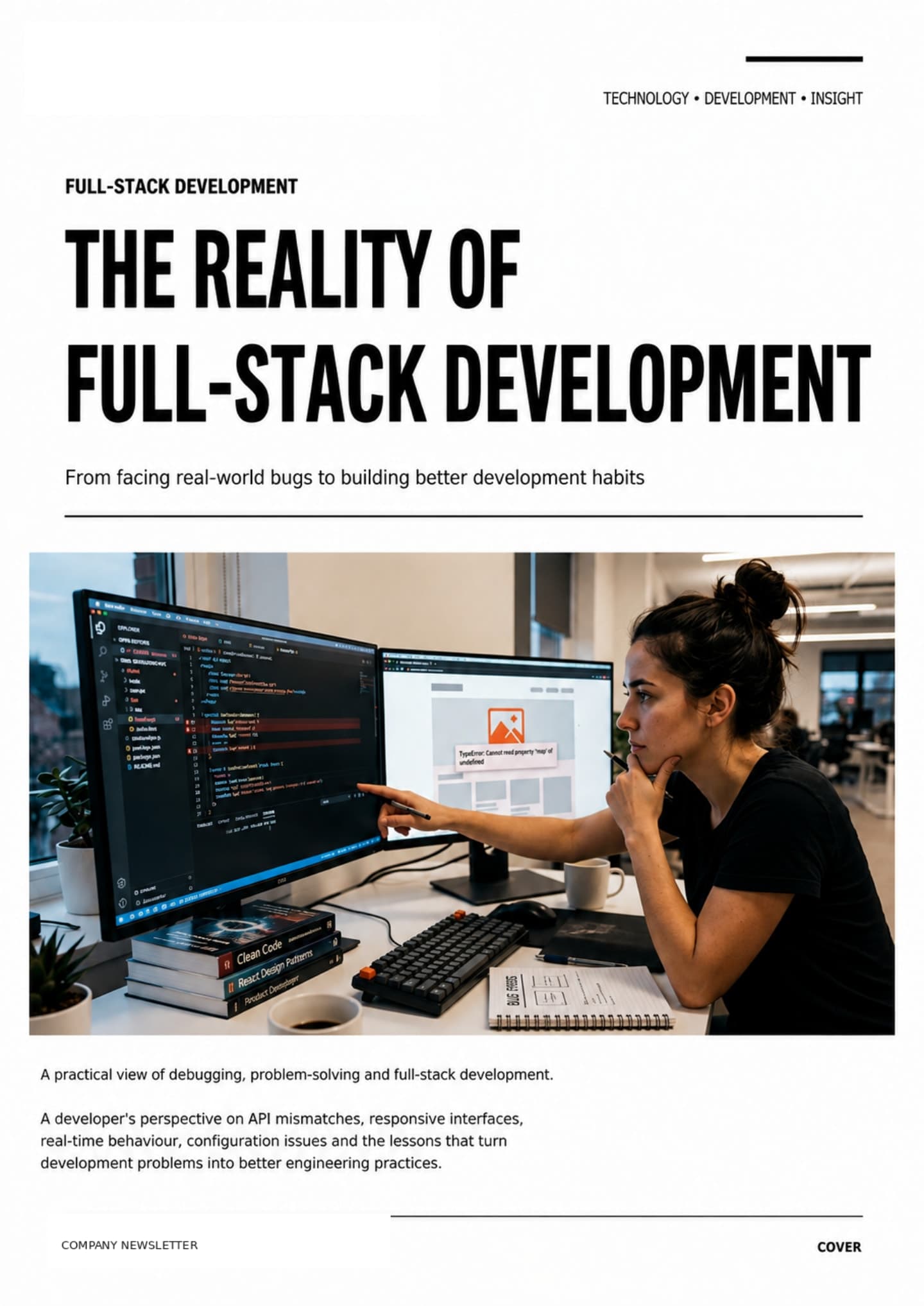
During development, I faced situations where a screen looked correct but the API response did not match what the interface expected. I also dealt with responsive layout issues, stale data, notification navigation problems and environment-specific build failures. These experiences showed me that a visible bug is often only
a symptom of a deeper problem in the complete workflow.
THE LESSON BEHIND THE BUG
One important lesson was understanding the complete data flow. Instead of looking only at the screen where an error appears, I now trace the journey from the user's action to the API request, business logic, database update, response and final UI state. This
makes debugging more structured and helps identify the actual root cause.
I also learned that correct data is not always current data on the screen. When one action affects another user's view, synchronization becomes part of the feature. Notifications must not only arrive; they must also take users to the correct context, whether the application is open, in the background or closed.
WHAT I DO DIFFERENTLY NOW
I have become more careful about the small details that are easy to overlook during development. Before considering a feature complete, I check how it behaves with missing data, slow responses, unexpected input and repeated actions. This helps me catch problems before they reach testing or users.
I also learned the value of keeping the frontend and backend conversation clear. Understanding the API contract, validation rules and expected states early reduces rework and makes implementation more predictable.
DESIGNING FOR REAL USERS
Responsive development gave me another practical lesson. A layout that works perfectly on a laptop may fail on a smaller screen. Fixed widths, long text,
rigid rows, dialogs and keyboard behavior can all affect whether a user can actually complete a task. I now consider responsiveness part of functionality, not just visual design.
CODE, CONFIGURATION OR ENVIRONMENT?
Not every issue is caused by application code. I have faced problems involving SDK configuration, dependency versions, database connections, cache behaviour, storage limitations and differences between development environments. Before changing working code, I now ask whether the problem is actually in the code, the configuration or the environment.
HOW MY APPROACH CHANGED
These experiences changed my development habits. I verify API contracts instead of assuming response formats. I consider loading, empty, success and error states early. I test different screen sizes, slow responses, repeated actions and different application lifecycle states. I also separate code problems from deployment and environment problems before starting a fix.
The biggest lesson is simple: good full-stack development is not about avoiding every bug. It is about understanding why something failed, solving the root cause and carrying that lesson into the next feature. Every difficult issue has improved the way I design, debug, test and think about software.
FROM FIXING BUGS TO PREVENTING THEM
Another important change is how I approach debugging. I try not to make several changes at once. I reproduce
the issue, isolate the failing part, follow the data flow and then make the smallest correct fix. After that, I test the surrounding workflow instead of checking only the original error.
“A feature is not finished when it works on my screen; it is finished when the complete user journey works.”