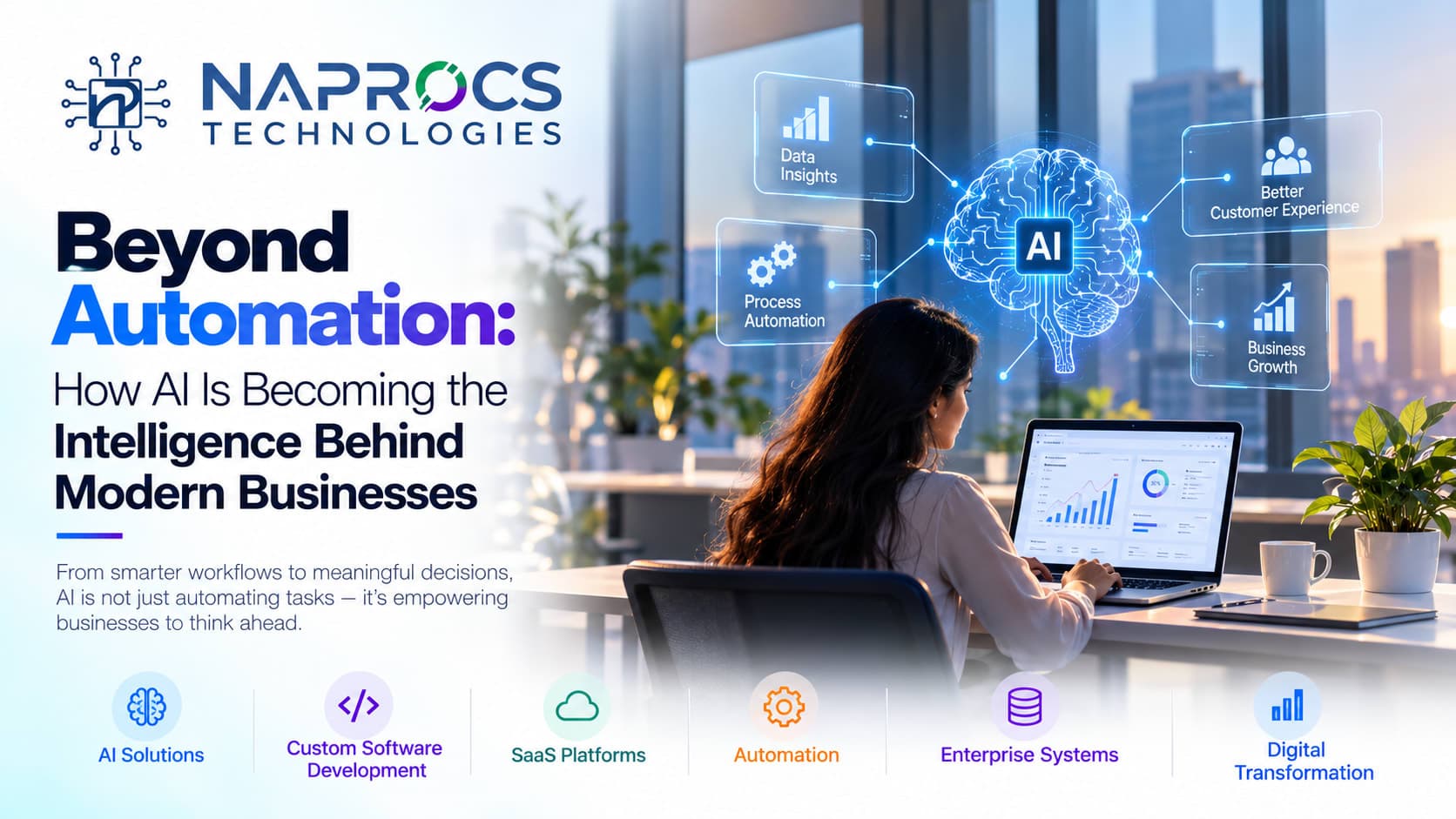
Artificial Intelligence is no longer something businesses discuss only as a future possibility. It is becoming part of everyday operations — helping teams make faster decisions, automate repetitive work, understand customers, and build products that can adapt to changing needs. This article explores how AI is moving beyond simple automation and becoming an intelligent layer across modern businesses, while highlighting why responsible engineering, human judgment, and scalable technology remain essential.
Introduction
A few years ago, when people talked about Artificial Intelligence, the conversation often revolved around chatbots, recommendation systems, or futuristic ideas. Today, AI is much closer to the way businesses actually operate.
A customer support team can use AI to understand customer queries. A business can analyse large amounts of data without manually going through thousands of records. Developers can use AI-assisted tools to speed up parts of the software development process. Even routine business workflows can be connected and automated.
But there is an important difference between using AI and building an intelligent business.
Adding an AI feature to an existing product does not automatically make that product intelligent. The real value comes when AI is connected to good data, reliable software architecture, business processes, and — most importantly — human decision-making.
That is where the next phase of AI becomes interesting.
From Automation to Intelligence
Traditional automation works mainly with predefined rules.
For example:
If a customer places an order, send a confirmation email.
The process is useful, but predictable.
AI can take the same process further. Instead of simply sending an email, an intelligent system could understand the customer’s behaviour, identify unusual activity, predict what information the customer may need, and help the business respond appropriately.
The shift is subtle but significant.
Automation asks: “What should happen when this condition occurs?”
AI asks: “What is happening, why is it happening, and what should we consider doing next?”
This ability to work with patterns, context, and large volumes of information is what makes AI increasingly valuable to modern organisations.
AI Is Changing the Way Software Is Built
The impact of AI is not limited to the final product. It is also changing software development itself.
Developers today can use AI-assisted tools for activities such as generating code suggestions, analysing errors, creating test cases, understanding documentation, and exploring possible implementations.
However, this does not eliminate the need for developers.
In fact, it makes engineering judgment even more important.
AI can suggest an implementation, but a developer still has to ask:
Is the solution secure?
Will it scale?
Is the architecture maintainable?
What happens when the system receives unexpected input?
How will user data be protected?
Does the solution actually solve the business problem?
The best engineering teams therefore do not treat AI as a replacement for technical thinking. They use it as an additional capability.
Data Is the Foundation
An intelligent system is only as useful as the information it can work with.
Businesses generate enormous amounts of data every day — customer information, transactions, operational records, documents, application logs, inventory information, and user interactions.
The challenge is not simply collecting this data.
The challenge is turning it into something useful.
This is why modern AI systems increasingly depend on strong data pipelines, databases, APIs, security controls, and well-designed software architecture.
When these foundations are weak, even an impressive AI model can produce unreliable results.
When the foundations are strong, AI can become a powerful layer for decision-making.
Building AI That Solves Real Problems
One of the biggest lessons from the current AI wave is that technology should not be built simply because something is technically possible.
A better question is:
What problem are we solving?
For example, imagine a business spending several hours every week manually reviewing reports. An AI-powered system could summarise those reports, highlight unusual patterns, and bring the most important information to the team’s attention.
The value is not the AI model itself.
The value is the time saved and the better decisions made because of it.
This problem-first approach is particularly important for companies building custom software and enterprise solutions. Every organisation has different workflows, users, data, and constraints. A solution that works for one business may not work for another.
Good technology therefore begins with understanding the problem before choosing the technology.
The Human Side of AI
There is another part of the AI conversation that deserves equal attention: people.
AI can process information extremely quickly, but businesses still need people who understand context, responsibility, ethics, and consequences.
Consider an AI system that recommends an important business decision. The recommendation may be useful, but someone still needs to understand why the recommendation was made and whether it makes sense in the real-world situation.
This is why the future is unlikely to be simply AI versus humans.
It is more likely to be humans working with AI.
The strongest organisations will be those that know which decisions should be automated, which decisions should be assisted by AI, and which decisions should remain firmly under human control.
Security Cannot Be an Afterthought
As AI becomes more deeply connected to business systems, security becomes even more important.
An AI system may interact with sensitive customer information, internal documents, databases, APIs, or operational workflows. A security weakness in any connected component can therefore become a serious business risk.
Secure authentication, authorization, data protection, input validation, audit logging, access control, and careful handling of AI-generated outputs should be considered from the beginning of development.
AI-first should never mean security-last.
What the Future Looks Like
The next generation of software will probably not always look like a separate “AI application.”
Instead, intelligence will increasingly become part of the software people already use.
A CRM may identify customers who need attention.
An inventory platform may predict potential shortages.
A financial system may identify unusual transactions.
A healthcare platform may help organise large volumes of information.
A developer platform may detect problems before they reach production.
In each case, AI becomes an intelligence layer within a larger software system.
That is a more practical and sustainable vision of AI — not technology for the sake of technology, but intelligence embedded into systems that solve real problems.
Conclusion
Artificial Intelligence is changing the software industry, but its biggest impact may not come from the most impressive demonstration or the newest model.
It will come from the systems that quietly make businesses better.
The future belongs to technology that combines intelligent software, strong engineering, reliable data, thoughtful design, and human judgment.
For technology companies, the challenge is therefore no longer simply to ask, “Can we build it?”
The more important question is:
“Can we build it responsibly, securely, intelligently, and in a way that creates real value?”
That is where AI moves beyond automation — and becomes a genuine part of how modern businesses think, operate, and grow.