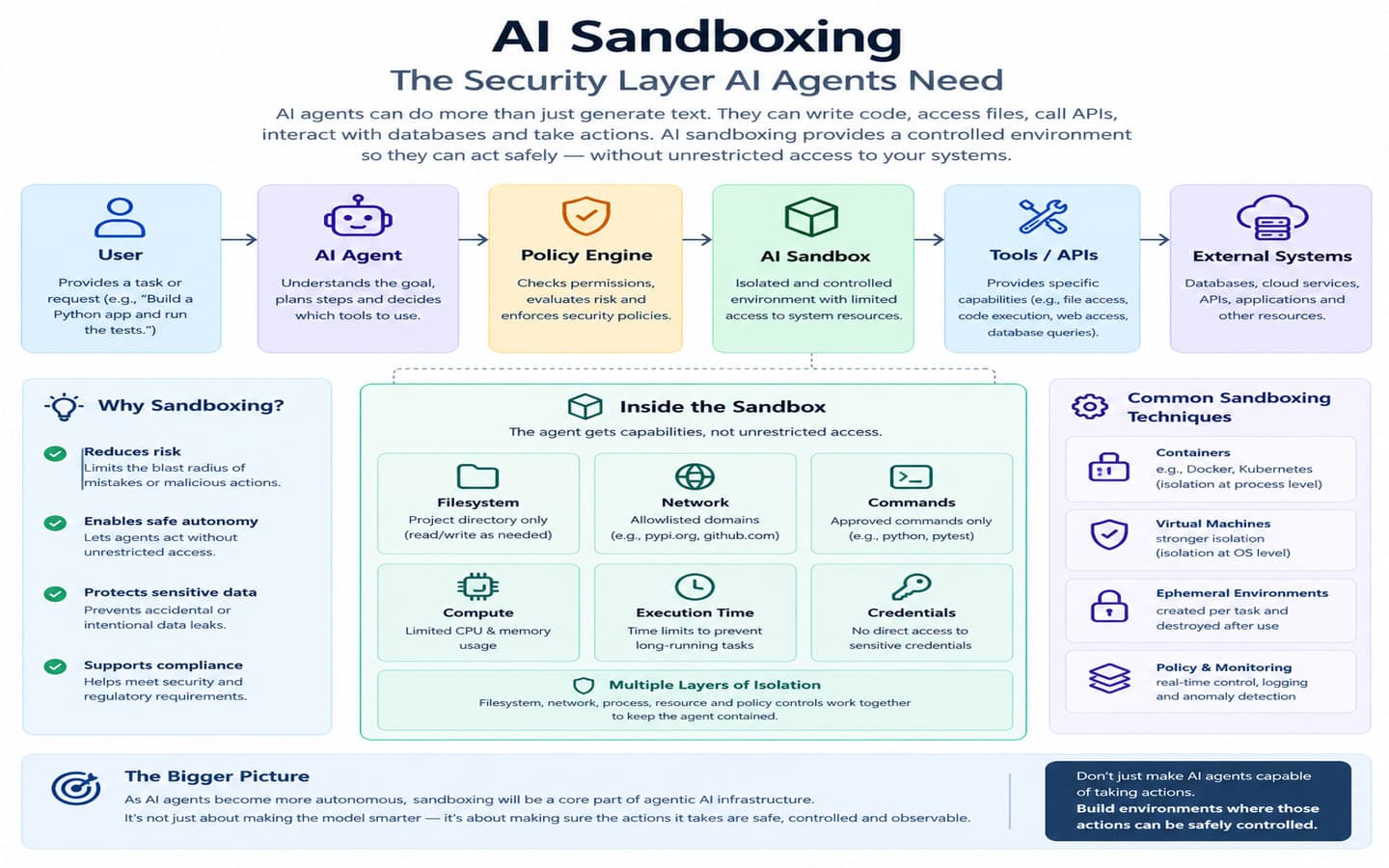
Executive Overview: The Shift to Actionable Intelligence
Artificial intelligence is progressing beyond passive text generation into autonomous agency. Modern AI agents are empowered to write and execute code, browse the web, manipulate filesystems, invoke third-party APIs, query production databases, and carry out multi-step workflows with limited human oversight. However, granting models agency introduces unprecedented security risks. Solving this challenge cannot rely merely on training more capable or aligned models; organizations must explicitly control where an AI operates and enforce strict boundaries on what it is permitted to touch.
Defining AI Sandboxing
AI sandboxing is the practice of running an autonomous agent inside an isolated, highly controlled runtime where access to host systems and external infrastructure is strictly governed. Instead of granting the agent raw execution access on developer machines or production servers, the architecture interposes an isolation boundary governed by strict security policies. Within this perimeter, the agent receives fine-grained, task-specific capabilities rather than blanket operational privileges.
Blast Radius Mitigation in Agentic Workflows
Consider an autonomous coding agent tasked with scaffolding and testing a software service. Fulfilling this request requires creating files, modifying source modules, fetching external dependencies, running build commands, and inspecting logs. If given raw operating system access, a hallucinated command, prompt injection, or poisoned dependency could compromise the entire environment. A hardened sandbox constrains filesystem modifications strictly to the designated project directory, enforces process and command allowlists, throttles compute resources, and prevents unauthorized credential discovery.
Defense-in-Depth: Beyond Containerization
A common architectural misconception is that deploying an agent inside a standard Docker container automatically provides sufficient security. While containers offer process isolation, comprehensive sandboxing demands a multi-tiered defense strategy. True isolation encompasses runtime policy enforcement, strictly defined tool boundaries, filesystem segregation, granular network filters, and hardware resource limits. Each distinct layer establishes a verifiable boundary between untrusted model decisions and underlying host infrastructure.
Enforcing the Principle of Least Privilege
Least privilege forms the bedrock of agent containment. If an agent requires local file modifications to fulfill a request, it has no operational justification for accessing root directories or reading adjacent user data. Likewise, when pulling specialized packages, agents do not require unbounded internet access. Transitioning from coarse system permissions to granular capability delegation ensures that every filesystem path, approved binary, and execution timeout is bound strictly to the task's scope.
Architectural Separation: Authority vs. Autonomy
Traditional application architectures follow deterministic paths from user interface to business logic and data stores. Agentic systems introduce dynamic planning, tool selection, and autonomous execution. Consequently, the architecture must maintain clear separation of responsibilities: the agent determines proposed actions, but the policy engine decides whether those actions are permissible, the sandbox defines where they run, and external systems independently authorize execution. The AI must never serve as the final authority for its own permissions.
The Frontier of Agentic Infrastructure
As AI transitions toward production autonomy—managing cloud infrastructure, executing enterprise workflows, and automating browser operations—security evaluations can no longer hinge solely on model intelligence benchmarks. The primary evaluation must focus on operational safety and containment. Industry initiatives, such as NVIDIA's Open Agent Safety Platform with OpenShell and Sentry, demonstrate the urgent transition toward dedicated runtimes and real-time monitoring infrastructure for safe agent execution.