Introduction
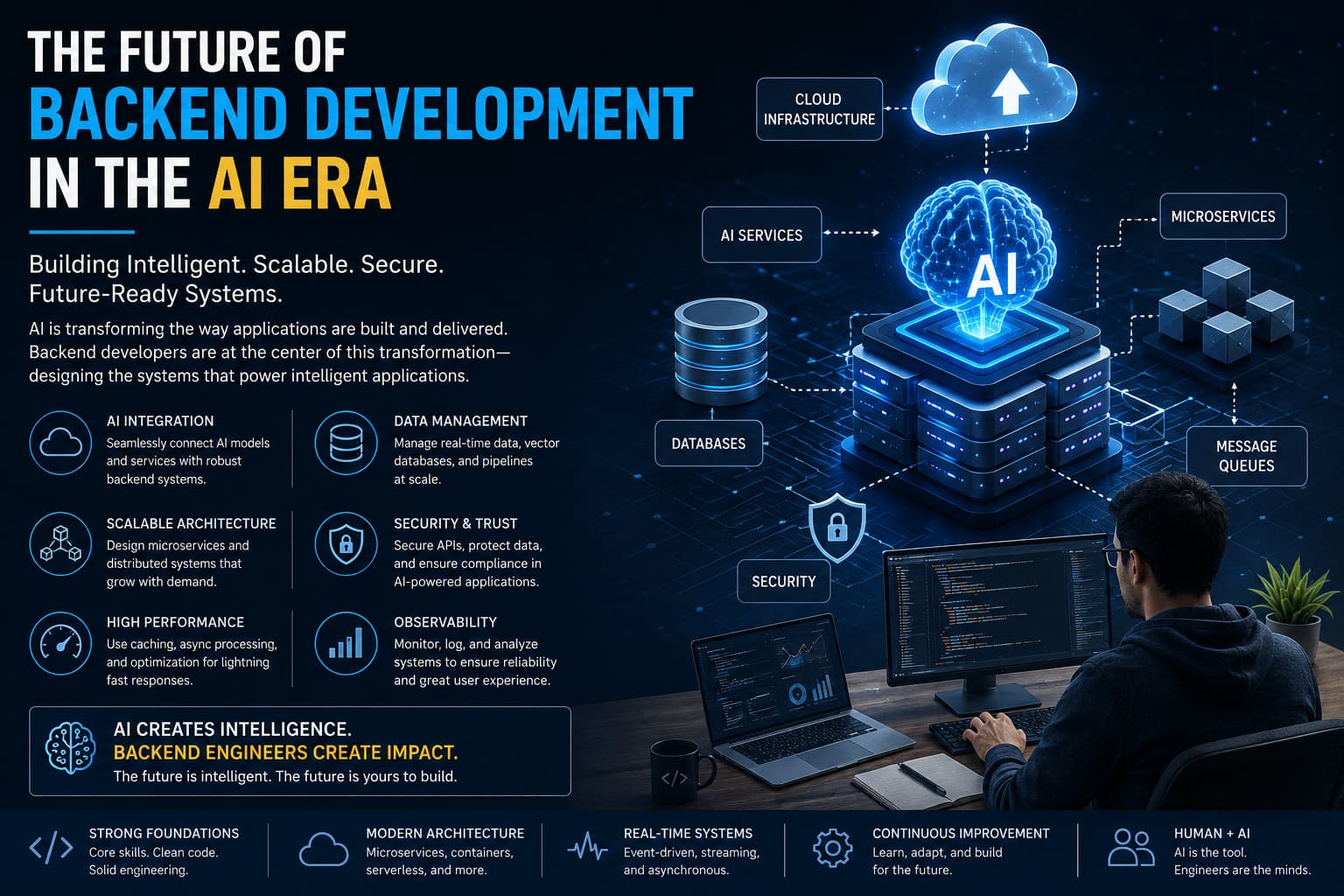
Artificial Intelligence is transforming software development faster than almost any previous technology shift. Generative AI, intelligent automation, recommendation systems, AI assistants, and autonomous workflows are moving from experiments into production applications. As this happens, backend development is entering a new phase. The important question is no longer whether AI will affect backend engineering, but how backend developers will adapt and create value in an AI-driven software industry.
AI is not removing the need for backend engineering. It is raising the level at which backend engineers are expected to operate.
01 | BACKEND DEVELOPMENT IS EVOLVING, NOT DISAPPEARING
AI coding tools can generate boilerplate code, suggest implementations, explain unfamiliar code, write tests, and help developers debug faster. This increases productivity, but software engineering is much larger than code generation. Production systems require architecture, data design, security, observability, reliability, scalability, and careful decisions about how components behave under failure.
A developer may ask AI to generate a service, but an engineer must decide whether that service belongs in the architecture, how it communicates with other services, how it scales, and what happens when it fails.
02 | AI APPLICATIONS NEED STRONG BACKEND FOUNDATIONS
An AI model by itself is not a complete application. Real products need a backend layer that authenticates users, validates requests, retrieves information, communicates with AI services, stores results, manages permissions, and monitors system health. The backend is the control layer that turns an AI capability into a dependable product.
For example, an AI-powered business application may combine REST APIs, databases, caching, message queues, cloud services, monitoring, and AI model APIs. The intelligence may come from the model, but the reliability of the product comes from the system around it.
03 | APIs WILL BECOME THE BRIDGE TO AI
APIs have always connected applications and services, but AI is making these interactions more dynamic. Backend services can now send structured context to an AI model, receive a response, validate it, enrich it with application data, and return a controlled result to the user. This creates new backend responsibilities around latency, rate limits, authentication, error handling, cost control, and response validation.
Future backend engineers will increasingly design APIs that connect users, business logic, data platforms, and intelligent services into one reliable workflow.
04 | DATA WILL BECOME A STRATEGIC ASSET
AI systems depend on data, and backend systems are responsible for collecting, storing, protecting, and delivering that data. Modern applications may need transactional databases, caches, object storage, search systems, analytics platforms, and vector stores working together. Backend engineers therefore need to understand not only where data is stored, but how it moves through a system and how access to it is controlled.
Data quality, governance, security, and availability will directly influence the usefulness and trustworthiness of AI-powered applications.
05 | EVENT-DRIVEN ARCHITECTURE WILL GROW
As applications become more distributed, synchronous communication alone can create bottlenecks and tight dependencies. Event-driven architecture allows services to communicate through events and process work asynchronously. A single business event can trigger multiple independent actions such as payment processing, inventory updates, notifications, analytics, or AI-based analysis.
Platforms such as Apache Kafka and other messaging systems are increasingly valuable for building resilient, scalable applications that must process data and events in real time.
06 | CLOUD AND DISTRIBUTED SYSTEMS ARE THE NEW BASELINE
AI workloads can be unpredictable and resource-intensive. A production application must be capable of handling changing traffic, background processing, model requests, large datasets, and partial service failures. This makes cloud infrastructure, containers, microservices, load balancing, auto-scaling, caching, and observability important parts of modern backend engineering.
The question is no longer only, 'Does the application work?' It is, 'Can the application continue to work reliably as demand, data, and complexity increase?'
07 | AI WILL CHANGE DEVELOPER PRODUCTIVITY
AI assistants will increasingly become part of everyday development. They can help engineers generate repetitive code, review logic, create tests, summarize logs, and explore unfamiliar repositories. This can shorten development cycles and allow engineers to focus more on architecture and problem solving.
However, AI-generated code still requires human review. Security vulnerabilities, incorrect assumptions, inefficient queries, poor error handling, and architectural mistakes can all be hidden behind code that looks correct. The ability to verify and improve AI output will be a core engineering skill.
08 | SECURITY AND TRUST WILL MATTER MORE
AI-powered applications can process sensitive business and user information, making security a first-class backend responsibility. Authentication, authorization, encryption, validation, secrets management, audit trails, secure API design, and monitoring must be considered from the beginning rather than added after development.
As systems become more intelligent and interconnected, protecting data and controlling access becomes just as important as delivering functionality.
09 | THE BACKEND DEVELOPER OF THE FUTURE
The strongest backend developers will combine traditional engineering fundamentals with modern architectural and AI capabilities. Core programming, databases, APIs, data structures, and clean code remain essential. Alongside them, developers will benefit from knowledge of microservices, distributed systems, event-driven architecture, cloud platforms, system design, observability, security, and AI integration.
Future-ready developers do not need to become AI researchers. They need to understand how to use AI capabilities inside systems that are reliable, scalable, secure, and maintainable.
10 | SYSTEM THINKING WILL BE THE DIFFERENTIATOR
AI can generate individual components quickly. The greater challenge is understanding how those components behave together. System thinking means considering dependencies, failure modes, data consistency, performance, cost, security, and user impact before implementation. As routine coding becomes faster, this broader engineering perspective becomes more valuable.
The best backend engineer of the AI era will not be the person who writes the most code. It will be the person who can design the right system, make sound trade-offs, and keep that system reliable in the real world.
Conclusion
The AI era will change backend development, but it will not make backend engineering irrelevant. Instead, it will push the profession toward deeper architecture, stronger system thinking, better data management, and smarter use of automation. AI will accelerate implementation, while engineers remain responsible for the design, reliability, security, and business value of the systems they build.
The future of backend development is not about competing with AI. It is about building the systems that make AI useful, reliable, secure, and scalable in the real world.