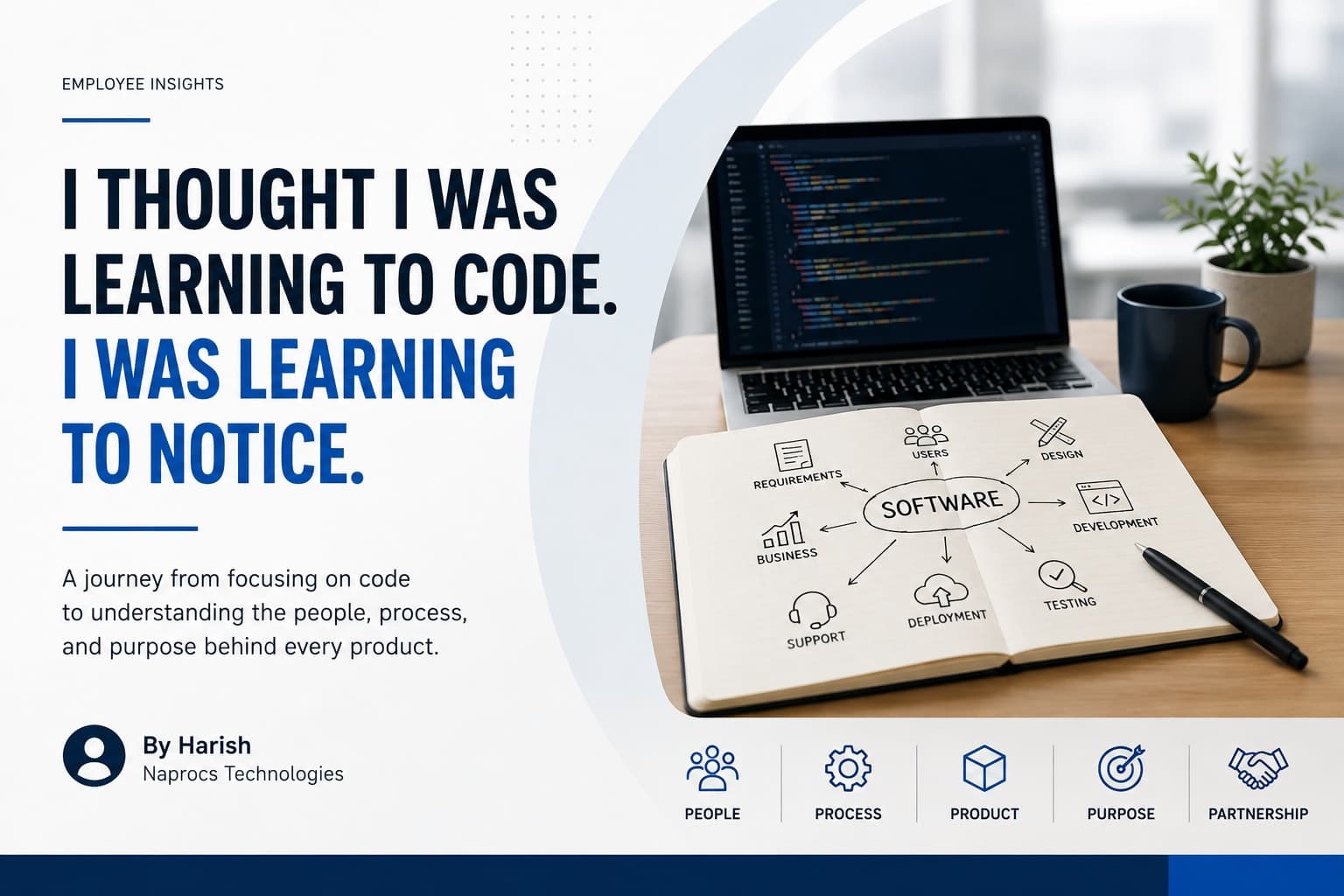
Before I joined Naprocs, my idea of becoming a good developer was fairly simple. Learn programming. Learn frameworks. Build projects. Get hired. Get better. In my head, that was the whole ladder. I knew, in a vague way, that companies also had departments like sales, marketing, HR, and client management, but I didn't really think about how any of that connected to the software itself. The code was the product, as far as I was concerned. Everything else was just things that happened around it.
That belief didn't collapse in one dramatic moment. It wore down slowly, project by project, conversation by conversation, until one day I realized I wasn't thinking about my work the same way anymore.
Seeing the Rest of the Room
Once I was actually inside the company, I started noticing how much had to happen before a single line of code was written, and how much had to happen after it was committed. There were discussions about what a client actually needed, not just what they'd asked for. There were decisions about how something should look and feel before anyone touched the frontend. There was testing, security review, deployment, and then after all of that the quieter, less glamorous work of maintaining and supporting something once it was already live.
None of this was explained to me as a lesson. I just kept running into it. And slowly, coding stopped feeling like the main event and started feeling like one stage in a much longer process a process that included understanding a business problem, planning a product, designing an experience, writing the code, testing it, deploying it, and then supporting real people who depended on it working.
From what I've seen so far, I'd guess writing the actual code is maybe a fifth or a third of what it takes to turn an idea into something people actually use and keep using. I'm not saying that as a fact about the industry it's just my own rough sense of it, based on what I've personally watched happen around my own work.
Learning Whatever the Project Needed
Something else changed too, and it wasn't really about the ecosystem it was about me. As a student, I got to choose what I learned. If I wanted to pick up a new framework, that was my decision, made on my own schedule. Inside the company, that logic reversed. The project decided what I needed to learn, and I had to catch up.
I ended up working across web and mobile, spending time in Flutter and Android Studio, touching backend and API work, moving between different frontend stacks depending on what a given project required. None of this was planned by me in advance. It just showed up, one requirement at a time. It taught me something I hadn't really internalized as a student: being a developer isn't about knowing one fixed set of tools. It's about being willing to pick up whatever the problem in front of you actually needs.
One Project That Made It Concrete
The clearest example of this, for me, was working on the Employee Management System. It isn't a small or simple application it involves close to nine or ten different roles, each with different permissions and different things they're allowed to see and do. Working on it meant thinking about role-based access, authentication, and authorization, not as abstract concepts from a course, but as decisions that directly shaped what a specific employee could or couldn't do on a given day.
It also meant realizing that "the frontend" and "the backend" aren't really separate worlds they're constantly negotiating with each other, and a lot of the real work is in making sure that negotiation holds up cleanly across every single role, not just the one you tested first. Debugging something in a system like that isn't just "find the bug." It's "find the bug, and figure out whether it behaves the same way for the other eight roles too."
I don't bring up the EMS because it was the most impressive project I've worked on. I bring it up because it's the clearest place where I could actually feel the distance between writing code and building something for someone. Writing the feature was one task. Making sure it worked for a warehouse employee, an HR manager, and an admin without breaking anyone's experience that was a completely different kind of thinking, and nobody had really described it to me before I had to do it.
A Different Way of Measuring Myself
Somewhere in the middle of all this, I noticed I'd stopped asking myself "is my code good?" as the main question. I'd started asking something closer to "does this actually work for whoever has to use it, and does it hold up under everything happening around it the business reason it exists, the client expecting it, the team maintaining it after I move on?"
That's not a more impressive question. It's not even a comfortable one, because it means I can write code I'm technically proud of and still have missed the point. But it's a more honest question, and it's the one that's actually stuck with me.
I still think being good at coding matters a lot. I'm not trying to talk myself out of caring about that. But I came into this company expecting the hard part to be getting better at writing code. What I didn't expect was that the harder, slower, more useful shift would be learning to pay attention to everything the code was sitting inside of.
I thought I was here to learn how to code better. It turns out I was here to learn how to notice more.