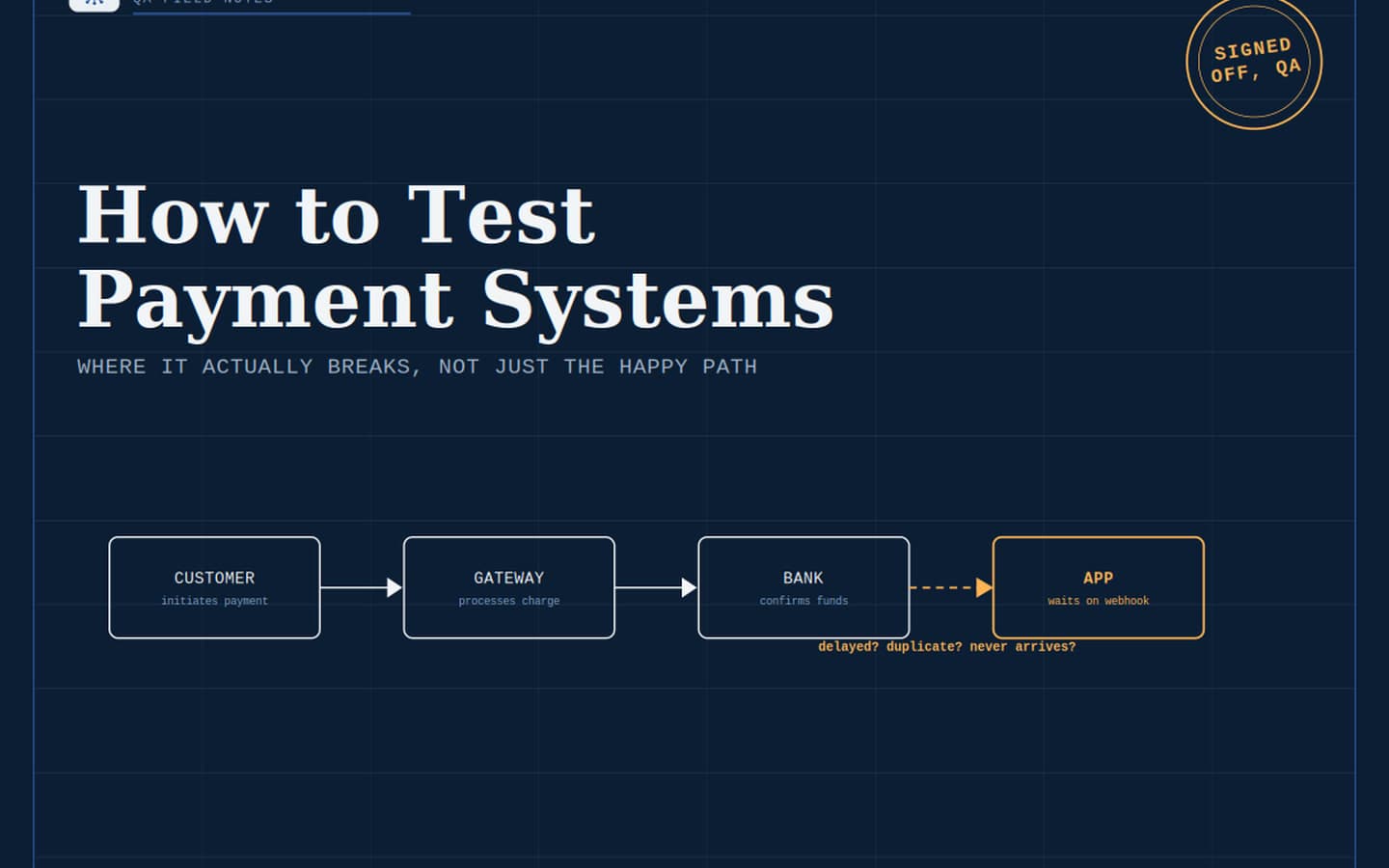
Payment systems are the one place where “it mostly works” isn’t good enough. A login bug annoys someone. A payment bug charges someone twice, or doesn’t charge them at all, or confirms an order that was never actually paid for. Testing payments properly means testing for the parts that don’t show up on a happy-path demo.
Start with the sandbox, but don’t trust it blindly
Every payment gateway gives you a sandbox and a set of test card numbers. That’s where testing starts, not where it ends. Sandbox environments are built to make the happy path easy: successful payment, successful webhook, clean response. Real failures look different — slow responses, dropped connections, webhooks arriving out of order, or not arriving at all. If your test plan only covers the test cards that gateways give you for “successful payment,” you’re testing the gateway’s documentation, not your own system.
Test what happens when the payment succeeds but your app doesn’t know it yet
Most payment flows depend on a webhook or callback telling your app “this payment succeeded.” But network calls fail, servers restart, and webhooks can arrive late, out of order, or twice. Ask: what does your app show the customer in the gap between “payment charged” and “webhook received”? What happens if the webhook never arrives at all? A lot of “my payment worked but the order shows as pending forever” bugs live exactly here.
Duplicate charges are a testing problem, not just a dev problem
If a customer double-clicks “Pay Now,” or their network retries a request automatically, does your system charge them once or twice? Idempotency, making sure the same request can’t accidentally repeat the same charge, has to be tested on purpose. It won’t show up by clicking through the flow once calmly. Try clicking pay multiple times quickly. Try replaying the same payment request manually. If nothing in your test plan tries to break this on purpose, assume it’s untested.
Refunds and partial refunds deserve their own test pass
Refund logic is often built and tested separately from the original payment flow, which means it’s easy for the two to drift out of sync. Test a full refund. Test a partial refund. Test refunding twice. Test refunding more than was originally charged. Check what the customer sees, and what your internal records show, after each of these — they should always match.
Currency, rounding, and the small numbers that add up
If your system touches more than one currency, or splits a payment into fees and taxes, rounding errors are a real source of bugs, usually tiny differences nobody notices until finance reconciles the books. Test with odd amounts, not just round numbers. ₹99.99 behaves differently than ₹100 once it’s split three ways.
Treat the payment gateway like something that can fail, because it will
Your test plan should include the gateway timing out, the gateway returning an error after the money was actually taken, and the gateway being temporarily unreachable. These aren’t edge cases — they happen in production, usually during your highest traffic moment. What does your app do when it doesn’t get a clean yes or no?
The takeaway
Testing a payment system isn’t really about testing payments. It’s about testing everything that can go wrong in between: the gap between “charged” and “confirmed,” the retry nobody expected, the webhook that showed up twice.
If your test plan only proves that payments work when everything goes right, it hasn’t actually tested the payment system yet.