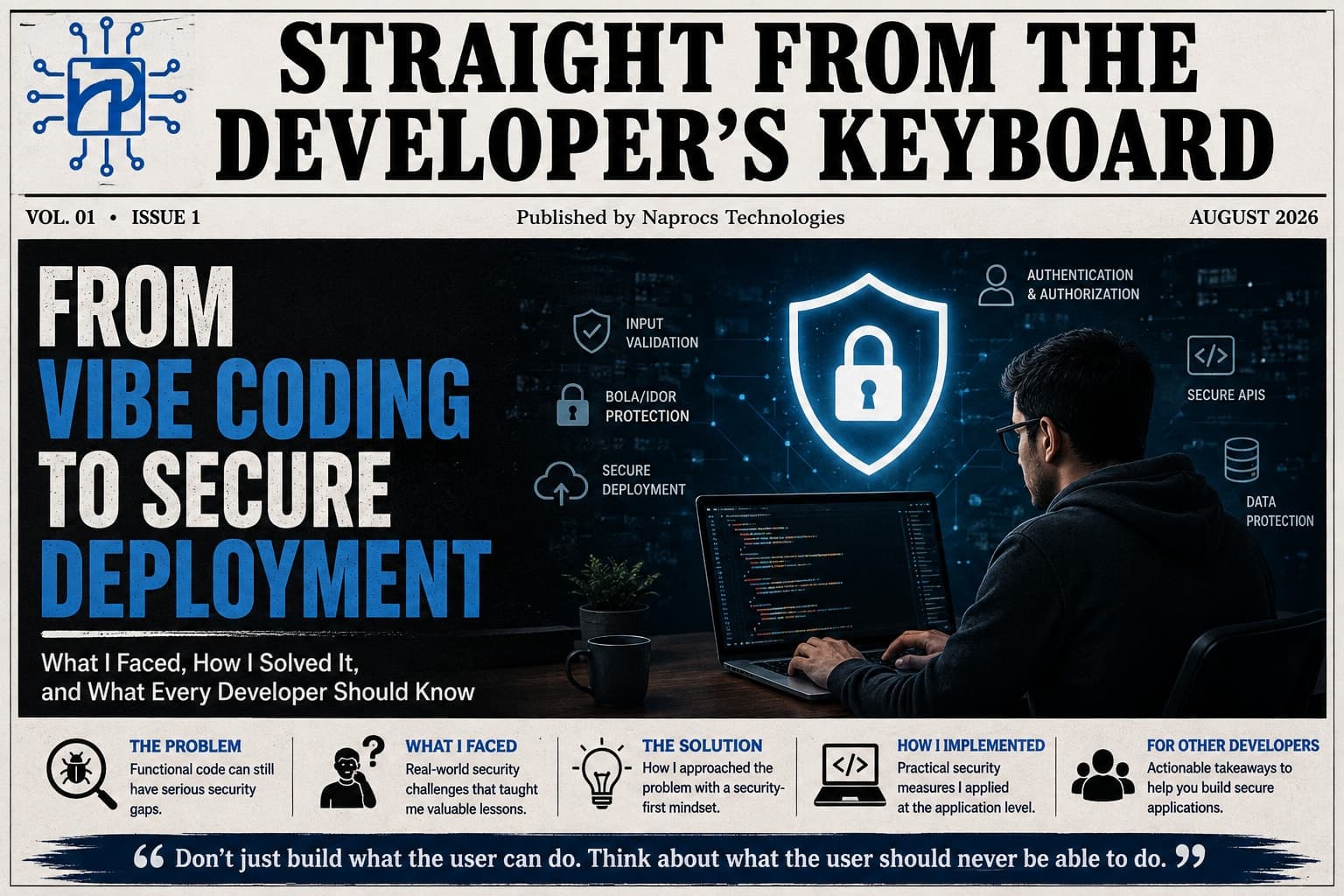
When we think about AI-assisted development, it is easy to focus on how quickly we can build an application. A prompt can generate a page, an API, a database model, or an authentication flow within minutes. But while working on real-world full-stack applications, I started to understand that getting a feature to work is only one part of development. The bigger question is whether that feature remains secure when a user interacts with the application in an unexpected way.
I experienced this more clearly while working on real applications where authentication, user roles, APIs, data ownership, file uploads, payments, sessions, and deployment all had to work together. These experiences changed the way I look at AI-generated code. Instead of asking only whether the code works, I started asking what could happen if someone tried to misuse it.
What Problem Did I Face?
The main problem was that a functional application can still contain security gaps. During normal development, it is natural to test a feature through the frontend: log in, click a button, submit a form, and check the expected result. However, a real user is not limited to that workflow. A user can call an API directly, change an object ID, modify a request body, repeat a sensitive request, or attempt to access information belonging to another user.
For example, simply hiding an administrative button does not prevent someone from calling the related API. Similarly, checking that an order or record exists is not enough; the backend must also check whether the authenticated user is actually allowed to access that resource. These situations made me realize that security has to be enforced at the backend and at the business-logic level, not only in the interface.
What I Faced While Working on the Application
One of the biggest challenges was understanding that security problems are connected. Authentication, authorization, API validation, database access, sessions, file uploads, payment processing, and deployment configuration cannot always be treated as separate features. A change in one area can affect another. For example, adding a new role means thinking about which APIs that role can access. Adding an object-based API means checking ownership. Adding a file upload means considering file type, size, storage, and access permissions.
I also had to consider cases where the frontend could be bypassed. Client-side validation is useful for user experience, but it cannot be treated as the final security layer. The backend needs to validate input again, verify the user's identity and permissions, and apply the business rules before performing the requested operation.
How I Solved the Problem
I approached the problem by reviewing the application from the perspective of an attacker rather than only from the perspective of a normal user. For each important feature, I asked questions such as: What happens if the user changes the ID? What happens if the frontend is bypassed? What happens if the request is repeated thousands of times? What happens if the user is not authorized? What happens if the input is malicious? What happens if a secret is exposed?
The first step was to strengthen authentication and authorization. I treated authentication as the process of identifying the user and authorization as the process of deciding what that user is allowed to do. Role-based access control was enforced on protected backend operations instead of depending only on hidden frontend controls.
I also added object-level authorization checks so that access to a resource was not determined only by an ID supplied by the client. The application needed to verify that the authenticated user, role, or tenant had permission to access the requested resource.
For credentials, passwords were protected using secure password hashing instead of storing plaintext passwords. Session handling was also treated as a security concern, with attention to secure cookies, session expiration, logout behavior, and preventing unauthorized reuse of session information.
Input validation was strengthened on the backend because requests cannot be trusted simply because they came from the application's own frontend. I also considered injection risks, safe handling of untrusted content, CORS restrictions, rate limiting for sensitive endpoints, and secure file-upload handling.
For payment-related functionality, I treated the frontend as untrusted. Payment success should not be decided simply because the browser reports that a payment was successful. The backend needs to independently verify the transaction and validate the relevant payment, order, and amount information before changing the application's payment status.
Sensitive configuration was separated from source code by using environment variables or appropriate secret-management practices. I also considered security headers, audit logging, dependency checks, and production configuration so that the application would not rely on development settings when deployed.
What I Learned From AI-Assisted Development
AI-assisted development can make implementation much faster, but generated code should not automatically be treated as production-ready code. When AI generates authentication logic, API routes, database queries, middleware, file-upload handling, or payment integrations, the developer still needs to understand what the code is doing and what assumptions it makes.
My approach became to use AI as a development accelerator rather than as a replacement for engineering judgment. I could use AI to generate an implementation, but I still needed to review the authorization rules, validate the request flow, test abnormal cases, and check whether security controls were actually enforced by the backend.
How I Implemented the Security Mindset
Instead of checking only whether a feature worked, I started testing the boundaries around the feature. For an API that accepts an ID, I considered whether changing that ID could expose another user's data. For an administrative operation, I checked whether the backend rejected unauthorized roles. For sensitive endpoints, I considered whether repeated requests could be abused. For uploaded files, I considered whether an untrusted file could create a security problem. For payment operations, I considered whether a client-side response could be manipulated.
This approach helped me move from feature-based development to security-aware development. The goal was not to assume that every user was malicious, but to make sure that the application did not depend on users behaving exactly as the interface expected.
How This Can Help Other Developers
The same approach can be useful for other developers, especially developers who use AI coding tools. Before deploying an AI-assisted application, it is useful to review authentication, authorization, object-level access, password handling, sessions, input validation, injection protection, XSS, CORS, rate limiting, file uploads, payment verification, secrets, security headers, logging, dependencies, and production configuration.
The most useful habit is to think about misuse before deployment. Ask what happens if a user changes an ID, bypasses the frontend, sends unexpected data, repeats a request, accesses another user's resource, or manipulates a business operation. These questions can reveal weaknesses that normal feature testing may not expose.
What Other Developers Can Take From My Experience
My biggest takeaway is that security should not be treated as a final checklist that is added just before deployment. It should be considered while designing the feature, implementing the backend, testing the API, connecting the database, integrating external services, and preparing the application for production.
Developers do not need to know every possible attack before writing code. But they should develop the habit of questioning trust boundaries. Whenever information comes from the client, ask whether it can be manipulated. Whenever an operation changes data, ask who is allowed to perform it. Whenever a third-party service is involved, ask what should be verified on the server.
My Biggest Learning
The biggest lesson I learned is that building secure software requires a different mindset from simply building functional software. AI can help me write code faster, but I still need to understand the code, test its assumptions, and make sure that security controls are enforced where they matter.
A developer should not stop at the question, “Does this feature work?” A better question is, “What happens when someone uses this feature in a way I did not expect?” That question has helped me think more like a production-minded full-stack developer.
Conclusion
AI-assisted development has changed how quickly applications can be built. But speed should not be confused with security. My experience with real-world full-stack applications taught me that authentication, authorization, validation, sessions, APIs, data ownership, payments, file uploads, secrets, and production configuration all need to be considered together.
The purpose of this approach is not to make development slower. It is to reduce avoidable security problems before they reach real users. AI can accelerate development, but developers remain responsible for understanding, reviewing, testing, and securing what they deploy.
Good development makes an application work. Good security makes sure it continues to work safely when users do not behave exactly as expected