Introduction
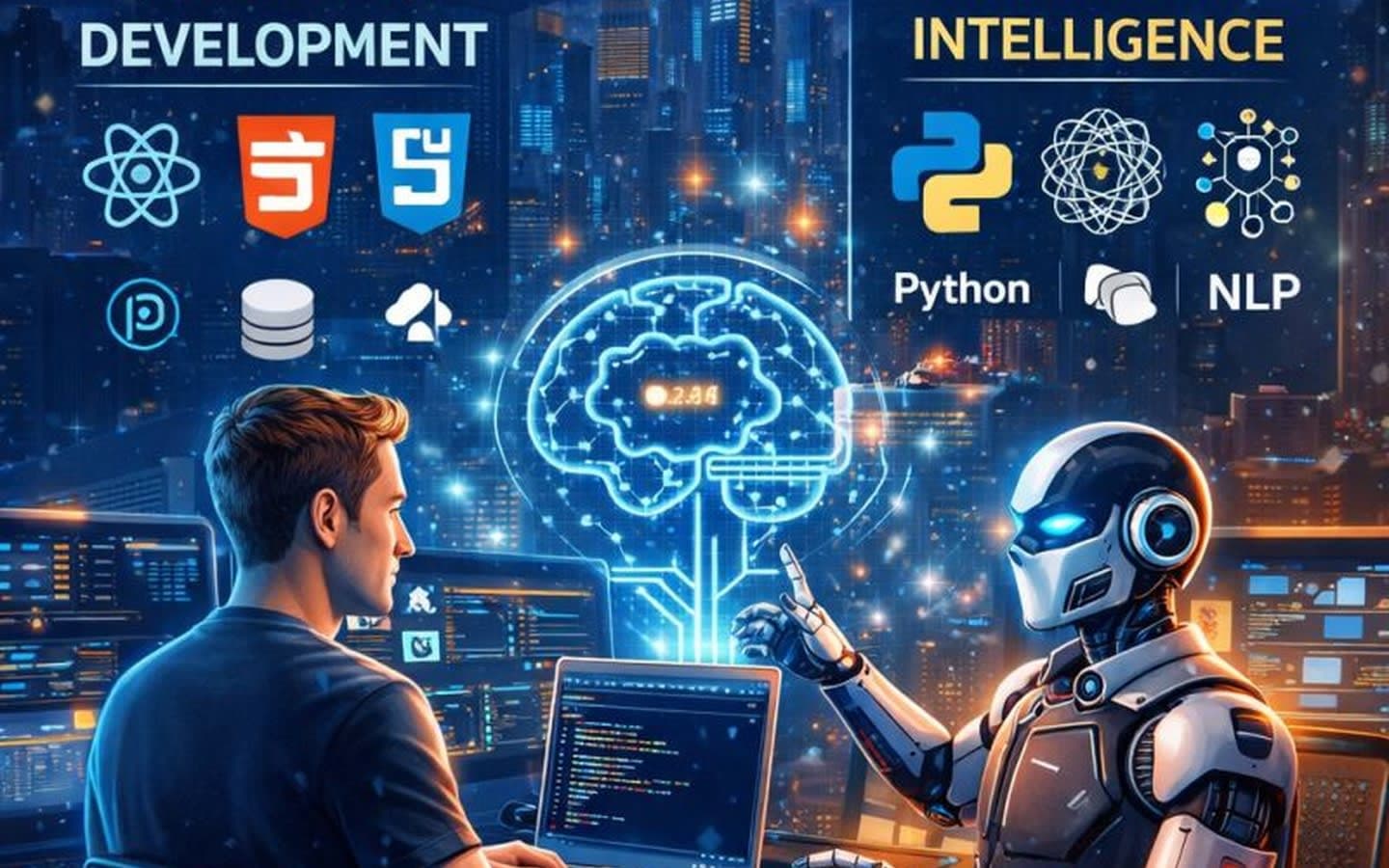
The technology industry is moving from traditional software development toward intelligent applications powered by Artificial Intelligence. However, Generative AI does not replace the need for strong software engineering. A developer who understands frontend, backend, databases, APIs, authentication, deployment, and debugging has a strong foundation for building reliable AI applications. The journey from Full-Stack Development to Generative AI is therefore a natural progression: first learn how software works, and then learn how to make software more intelligent.
1. Start with Strong Full-Stack Fundamentals
The first stage is understanding how a complete application works from end to end. Instead of learning technologies separately, understand how they communicate with each other.
· Frontend: HTML, CSS, JavaScript, React.js, React Hooks, state management, responsive design, reusable components, and user experience.
· Backend: Node.js, Express.js, REST APIs, routing, middleware, validation, error handling, authentication, authorization, and business logic.
· Database: SQL and NoSQL concepts, schema design, CRUD operations, relationships, indexes, transactions, and database security.
· Development tools: Git, GitHub, Postman, VS Code, npm, environment variables, logging, testing, and deployment.
· Architecture: understand client-server architecture, API communication, authentication flow, data flow, and separation of frontend, backend, and database responsibilities.
2. Learn Through Real Projects
Project-based learning is one of the most effective ways to connect theory with practical development. Begin with small applications and gradually increase their complexity. For example, build a Todo application first, then move to an authentication system, e-commerce application, booking platform, analytics dashboard, or business management system.
· Stage 1: Build simple CRUD applications and understand the complete request-response cycle.
· Stage 2: Add login, signup, JWT authentication, role-based access, validation, and protected routes.
· Stage 3: Add file uploads, email/OTP verification, payments, notifications, caching, and real-time features.
· Stage 4: Deploy the application and learn environment configuration, production errors, monitoring, and performance optimization.
· Stage 5: Add an AI feature such as an intelligent chatbot, document question-answering system, recommendation feature, or AI assistant.
3. Understand the Complete Application Flow
Whenever a feature is developed, trace the complete flow instead of focusing only on the visible screen. For example, when a user clicks a Login button, the frontend collects the credentials, sends an API request, the backend validates the request, checks the database, creates an authentication token, and returns a response. The frontend then stores the required information and updates the user interface. Understanding this flow makes both development and debugging easier.
4. Make Debugging a Daily Engineering Skill
Errors are a normal part of software development. The goal is not to avoid every error but to develop a systematic method for finding and fixing problems. Start by reproducing the issue and reading the exact error message instead of immediately changing code.
· Frontend debugging: check browser Console, Network requests, status codes, request payloads, response data, component state, props, and rendering conditions.
· Backend debugging: inspect server logs, routes, middleware, request body, authentication, validation, database queries, and response handling.
· Database debugging: verify the connection, database name, table or collection, query, field names, data types, indexes, and returned records.
· API debugging: use Postman or another API client to determine whether the problem is in the frontend or backend.
· Deployment debugging: check environment variables, build logs, server logs, CORS configuration, API URLs, database access, and production-only differences.
5. Use a Root-Cause Problem-Solving Method
A common mistake is treating the visible error as the actual problem. A 500 Internal Server Error, for example, only tells us that something failed on the server; it does not identify the root cause. A good developer traces the request backward until the actual cause is found.
· Define: What should happen, and what is actually happening?
· Reproduce: Can the problem be reproduced consistently?
· Isolate: Which layer is failing—UI, API, business logic, database, AI model, or deployment?
· Inspect: Read logs, inputs, outputs, stack traces, and network requests.
· Fix: Make the smallest appropriate change rather than rewriting unrelated code.
· Verify: Test successful cases, invalid inputs, edge cases, security, and performance.
· Document: Record the cause and solution so the same issue can be solved faster later.
6. Move from Full Stack to Generative AI
After gaining confidence in full-stack development, begin the AI journey. Start with Python and basic AI concepts before moving into advanced frameworks. The objective is to understand what happens behind an AI feature instead of simply calling an API without understanding it.
· Python: syntax, functions, classes, packages, APIs, JSON, data processing, and virtual environments.
· AI/ML foundations: datasets, models, training, inference, evaluation, classification, and basic neural-network concepts.
· Generative AI fundamentals: Large Language Models, tokens, prompts, context, embeddings, inference, structured outputs, and model APIs.
· Prompt engineering: clear instructions, context, examples, constraints, output formats, and evaluation.
· RAG: document loading, text extraction, chunking, embeddings, vector databases, retrieval, context injection, and grounded responses.
· Advanced AI applications: multimodal AI, AI agents, tool/function calling, workflows, memory, evaluation, and AI safety.
7. Connect AI with Full-Stack Engineering
A production AI application still needs normal software engineering. A chatbot needs a frontend interface, backend APIs, authentication, conversation storage, error handling, monitoring, and deployment. AI is an additional capability inside the application architecture.
For example, a company knowledge assistant can use React for the frontend, Node.js for backend APIs, a database for users and conversations, a vector database for document embeddings, and an LLM to generate answers from retrieved company information. This combination demonstrates why full-stack knowledge is valuable for Generative AI development.
8. Learn AI by Building Practical Applications
· AI Chatbot: create a chatbot that communicates with an LLM through a backend API.
· Document Q&A: upload PDFs or documents and ask questions using a RAG pipeline.
· Customer Support Assistant: combine authentication, conversation history, RAG, and an AI response system.
· AI Resume Assistant: analyze a resume, identify skills, and generate improvement suggestions.
· Business Analytics Assistant: allow users to ask questions about business data using natural language.
· AI Agent: create an application that can call tools such as search, database functions, or business APIs to complete tasks.
9. Improve by Testing and Measuring
AI applications require more than checking whether the application runs. Responses should also be evaluated for accuracy, relevance, consistency, latency, cost, and safety. Test both normal and difficult questions. For RAG systems, check whether the correct documents are retrieved before judging the generated answer. Keep sample questions and expected behavior so that changes to prompts, models, or retrieval logic can be tested systematically.
10. Security, Reliability, and Production Thinking
As applications become more intelligent, developers must also think about security. Never expose API keys in frontend code or source control. Validate user input, protect APIs, apply authorization, limit abusive requests, protect sensitive data, and log important failures without exposing private information. For AI applications, also consider prompt injection, unsafe outputs, data leakage, excessive tool permissions, and incorrect model responses.
11. A Practical Learning Routine
A consistent routine is more effective than trying to learn everything at once. A useful weekly cycle is: learn a concept, implement it, build a small feature, intentionally test failure cases, debug the problems, and write down what was learned. Spend less time copying tutorials and more time modifying projects and solving unfamiliar problems.
· Learn: understand the concept and why it is used.
· Practice: write the code yourself without blindly copying.
· Build: integrate the concept into a real project.
· Break: test invalid inputs and failure scenarios.
· Debug: find the root cause using logs and tools.
· Reflect: document the solution and identify what to improve next.
12. The Developer Mindset
The most important skill in this journey is not memorizing frameworks. It is learning how to think. Technologies, models, libraries, and tools will continue to change, but the ability to understand requirements, break complex problems into smaller parts, investigate failures, read documentation, and build reliable solutions remains valuable.
Conclusion
The journey from Full-Stack Development to Generative AI is a continuous learning path. Full-stack development provides the engineering foundation, while Generative AI adds new capabilities for understanding language, documents, images, data, and complex tasks. The strongest learning approach is to combine theory with projects, debugging with experimentation, and AI concepts with real software engineering.
The final goal is not to learn every framework or every AI model. The goal is to become a developer who can take a real-world problem, understand the requirements, select appropriate technologies, build the solution, debug failures, evaluate the result, secure the application, and continuously improve it. Learn → Build → Break → Debug → Solve → Improve. This cycle turns knowledge into practical engineering ability.