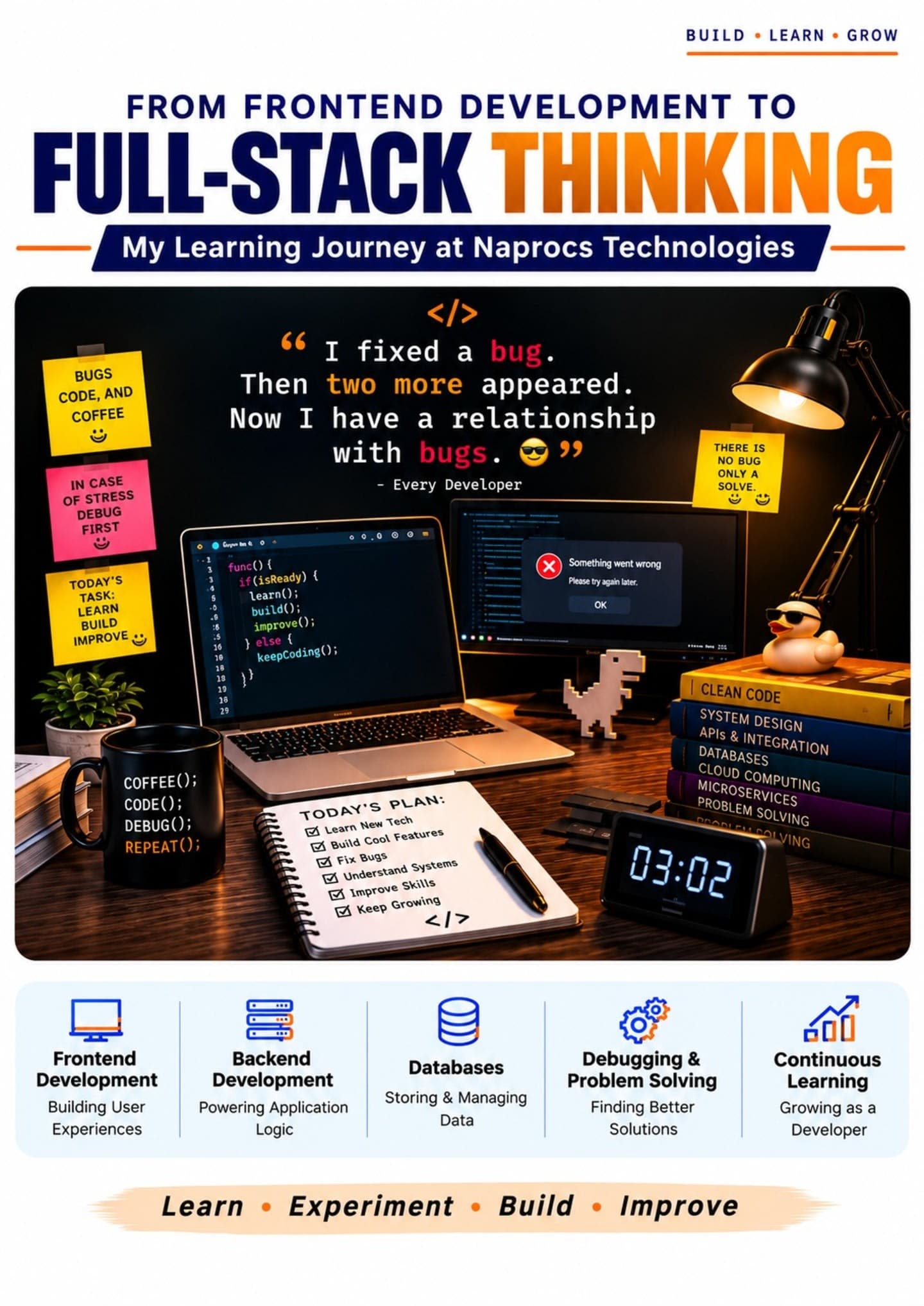
Introduction
Starting my professional journey as a Frontend Developer Intern at Naprocs Technologies has been an important learning experience for me. When I joined, my primary focus was frontend development, where I worked on building and improving user interfaces. As I became more involved in projects, I got the opportunity to work on full-stack applications and understand how different parts of an application work together. This experience helped me realize that software development is not limited to writing code for a particular layer of an application. Understanding how the frontend communicates with the backend, how data is processed, and how different components interact has helped me develop a broader perspective as a developer.
Starting with Frontend Development
My initial responsibilities were mainly focused on frontend development. I worked on creating user interfaces, implementing features, fixing UI-related issues, and making improvements based on project requirements. Frontend development taught me the importance of writing clean and maintainable code while also focusing on usability. A feature may work technically, but it also needs to provide a good experience for the user. While working on different features, I gradually became more comfortable with understanding existing code, identifying problems, making changes, and testing the results.
Getting Experience with Full-Stack Projects
One of the most valuable parts of my experience at Naprocs has been the opportunity to work on full-stack projects. Working on full-stack applications allowed me to understand that a feature usually involves multiple layers. A user interaction on the frontend may trigger an API request, which is processed by the backend, interacts with a database or another service, and finally returns a response that is displayed on the frontend. Understanding this flow changed the way I approached development. Instead of looking at a problem only from the frontend perspective, I started considering whether the frontend was sending the correct data, whether the API was receiving the expected request, whether the backend was processing the request correctly, whether the response was in the expected format, whether the frontend was handling the response properly, and whether the issue could be related to the database or another service. This way of thinking helped me become better at troubleshooting and understanding complete application workflows.
Learning Through Bug Fixing
Bug fixing has been one of the most practical learning experiences for me. Initially, when I encountered an issue, my first instinct was to focus on the place where the problem appeared. However, while working on real projects, I learned that the visible problem is not always the actual source of the bug. For example, if information is not displayed correctly on a webpage, the issue could be in the frontend logic, API request, backend processing, database response, or even the format of the returned data. I learned to approach bugs systematically by understanding the problem clearly, reproducing the issue, checking the browser console and network requests, verifying the API request and response, tracing the data flow between the frontend and backend, identifying the actual root cause, making the required change, testing the fix with different scenarios, and verifying that the change had not affected existing functionality. This process helped me move from simply fixing an error to understanding why the error occurred.
Improving My Problem-Solving Skills
Every bug or development challenge gave me an opportunity to improve my problem-solving ability. Sometimes the solution was straightforward. Other times, I had to understand unfamiliar code, investigate existing functionality, search documentation, test different approaches, and discuss the problem with experienced team members. I learned that debugging is not about immediately finding the answer. It is about asking the right questions and narrowing down the possible causes. This mindset has helped me become more patient and systematic while working on technical problems.
Developing My Backend Knowledge
Another important part of my learning journey has been my interest in backend development. Since I was primarily working as a frontend developer, I wanted to understand what happens behind the APIs and interfaces I was working with. Working on full-stack projects gave me the opportunity to explore backend concepts and understand how APIs, business logic, data processing, and databases contribute to an application. I am continuing to improve my backend knowledge because I believe that understanding both frontend and backend development will help me become a more effective software developer. Even when I am working on a frontend task, having an understanding of the backend helps me communicate better, troubleshoot issues more effectively, and understand the complete feature rather than just one part of it.
Learning from Real Project Experience
One of the biggest differences between learning through tutorials and working on real projects is the nature of the problems. Tutorials generally provide a predefined problem and solution, whereas real projects are different. Requirements can change, existing code may need to be understood, unexpected bugs can appear, and multiple technologies need to work together. Working in this environment taught me how important it is to understand requirements before implementing a feature, read and understand existing code, follow the project's development structure, test changes properly, debug issues systematically, learn from feedback, communicate when something is unclear, and continuously improve technical knowledge. These lessons have been valuable beyond any particular programming language or framework.
How This Experience Improved My Performance
As I gained more experience, I became more confident in approaching development tasks. I learned to spend more time understanding a problem before immediately writing code. I also became more comfortable investigating errors independently and using debugging tools to identify the root cause. My approach gradually changed from asking, "How can I make this feature work?" to asking, "How does this feature work, and what is the correct way to implement or fix it within the application?" That change in mindset has been one of the most important improvements in my professional development.
My Journey Ahead
My journey at Naprocs Technologies has helped me move beyond thinking only as a frontend developer. Working on full-stack projects has encouraged me to explore backend development and understand software applications from a broader perspective. I am still learning, and there is a lot more I want to explore in backend development, system design, APIs, databases, and application architecture. I believe that every project, feature, bug, and challenge provides an opportunity to learn something new. My experience so far has taught me that becoming a better developer is not only about learning new technologies. It is also about improving problem-solving skills, understanding real-world applications, learning from mistakes, accepting feedback, and continuously improving. Starting as a Frontend Developer Intern and getting the opportunity to work on full-stack projects has been an important step in my professional journey. I look forward to continuing this learning process, taking on more challenging responsibilities, and growing into a well-rounded software developer.