Introduction
When I started learning software development, I thought becoming a good developer mainly meant learning programming languages, frameworks, and writing good code.
After working on real projects, I have started to see it differently.
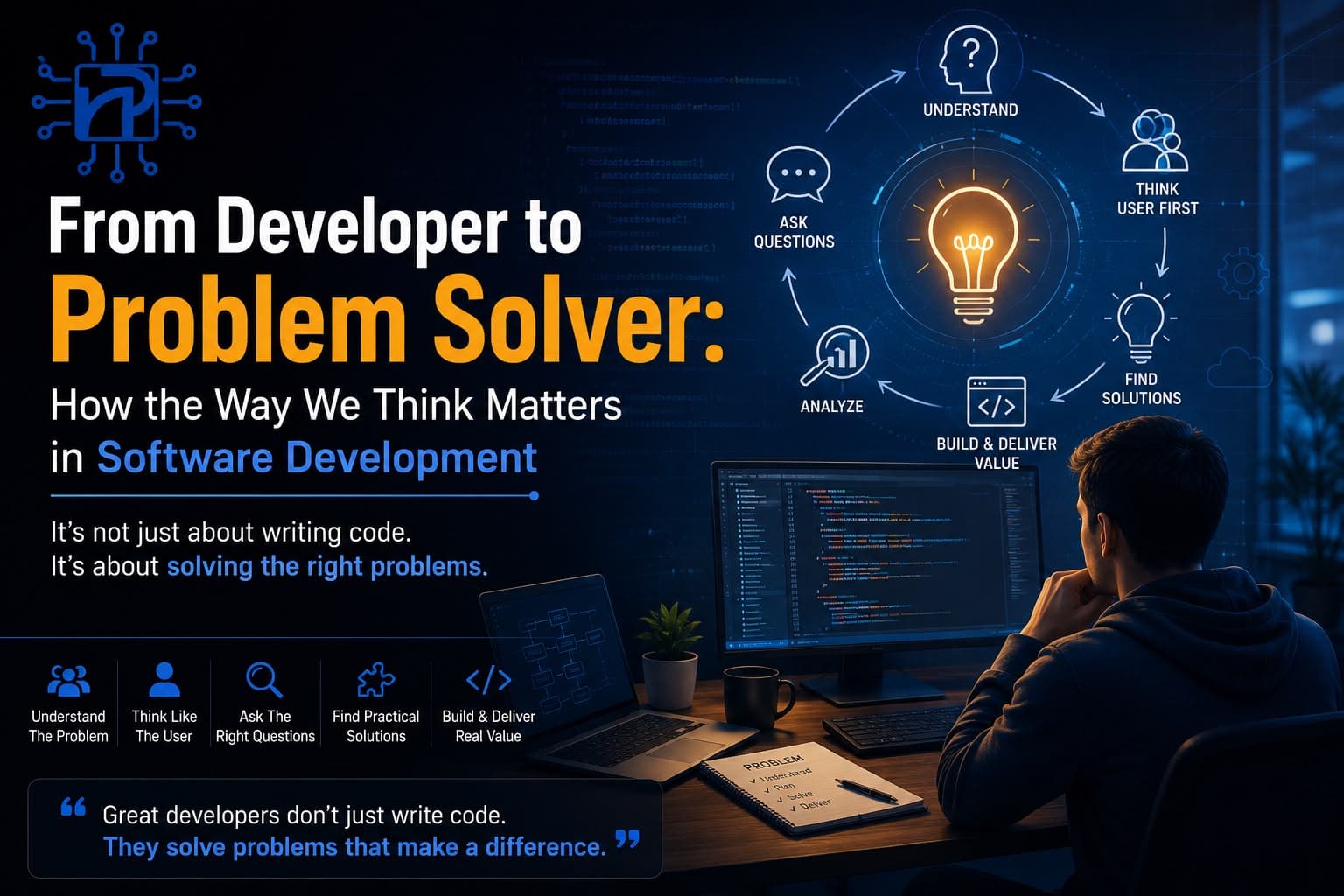
Writing code is only one part of development. A good developer also needs to understand problems, ask questions, think about users, and find practical solutions.
This is what slowly changes a developer from someone who writes code into someone who solves problems.
A Requirement Is Not Always the Complete Problem
In software projects, requirements are usually given as features.
"We need a search option."
It sounds simple, but several questions come with it.
What should users search? Should filters work with the search? What happens when there are no results? How should the user find what they are looking for quickly?
These details may not be part of the initial requirement, but they can have a major impact on the final product.
This taught me that instead of immediately asking "How do I build this?", we should first ask:
"What problem is this feature trying to solve?"
Asking Questions Is Part of Development
It can sometimes feel like asking too many questions will slow down development. In reality, asking the right questions early can save a lot of time later.
If a requirement is unclear and we make assumptions, we may build something that technically works but does not meet the actual expectation.
A short discussion at the beginning can prevent hours of rework.
For me, one important habit is:
Don't be afraid to ask why.
Think From the User's Perspective
Developers naturally think about code and technical implementation. Users think about completing their tasks quickly and easily.
They want to know:
Is it easy to use?
Can I find what I need quickly?
Is the information clear?
What happens if I make a mistake?
A feature can work perfectly from a technical perspective and still provide a poor user experience.
Before considering a feature complete, I believe we should ask: "If I were the user, would this actually be easy to use?"
Simple Solutions Can Be Better
Another lesson I have learned is that more complexity does not always mean a better solution.
Sometimes we think about adding new features when a small improvement to the existing workflow could solve the problem.
Good problem solving is not about creating the most complicated solution.
It is about finding a solution that works well for the actual problem.
Learning From My Current Project
My current project is a Laboratory Information Management System designed to manage the workflow of a diagnostic laboratory.
Working on this project has helped me understand the importance of looking beyond individual features.
Patient registration, test management, billing, sample collection, barcode management, result entry, reports, inventory, and user management may look like separate modules.
But when we understand the actual workflow, we see that they are closely connected.
Patient Registration → Test Selection → Billing → Sample Collection → Barcode → Testing → Result Entry → Verification → Doctor Approval → Final Report
A change in one stage can affect the stages that follow.
This made me realize that software should be designed around the complete business workflow, not just individual screens.
Understanding Different Users
The project also helped me understand how different users interact with the same system.
A receptionist may focus on patient registration and billing. A technician works with samples and test results. A doctor reviews and approves reports. A manager may monitor operations and financial information.
Each role has different responsibilities.
This showed me that role-based access is not simply a technical feature. It comes from understanding how the business actually operates.
A Working UI Is Not the Complete Solution
Another important learning is that a feature is not complete just because it works on the screen.
In a production system, the action also needs to work correctly with the backend and database.
When a patient is created, the data needs to be stored correctly. When a technician submits a result, it needs to be saved. When a doctor approves a report, that approval needs to be recorded.
This helped me understand that a good interface is only one part of a reliable application.
The complete workflow behind the interface is what makes the system useful.
Thinking About What Can Go Wrong
Real-world applications also require us to think about situations where things do not go as expected.
What happens if incorrect information is entered?
What happens if a user tries to access something they are not allowed to use?
What happens if a result needs to be changed after verification?
What happens if inventory becomes low?
Thinking about these situations has taught me to consider edge cases instead of focusing only on the normal workflow.
My Biggest Learning
My biggest learning from working on real projects is that development is not just about implementing requirements.
It is about understanding how those requirements fit into a larger process.
A developer needs to think about the user, the business, the data, security, workflow, possible errors, and what happens after an action is completed.
The better we understand the complete process, the better we can understand what the code actually needs to achieve.
Conclusion
Software development is much more than programming.
It requires technical knowledge, communication, problem-solving, business understanding, teamwork, and continuous learning.
Technology will continue to change, but the ability to understand problems and find practical solutions will always remain important.
My experience with real-world projects has helped me understand that becoming a better developer is not only about learning more technology. It is also about becoming better at thinking, questioning, understanding, and solving problems.
Because in the end, clients and users are not looking for code.
They are looking for solutions.