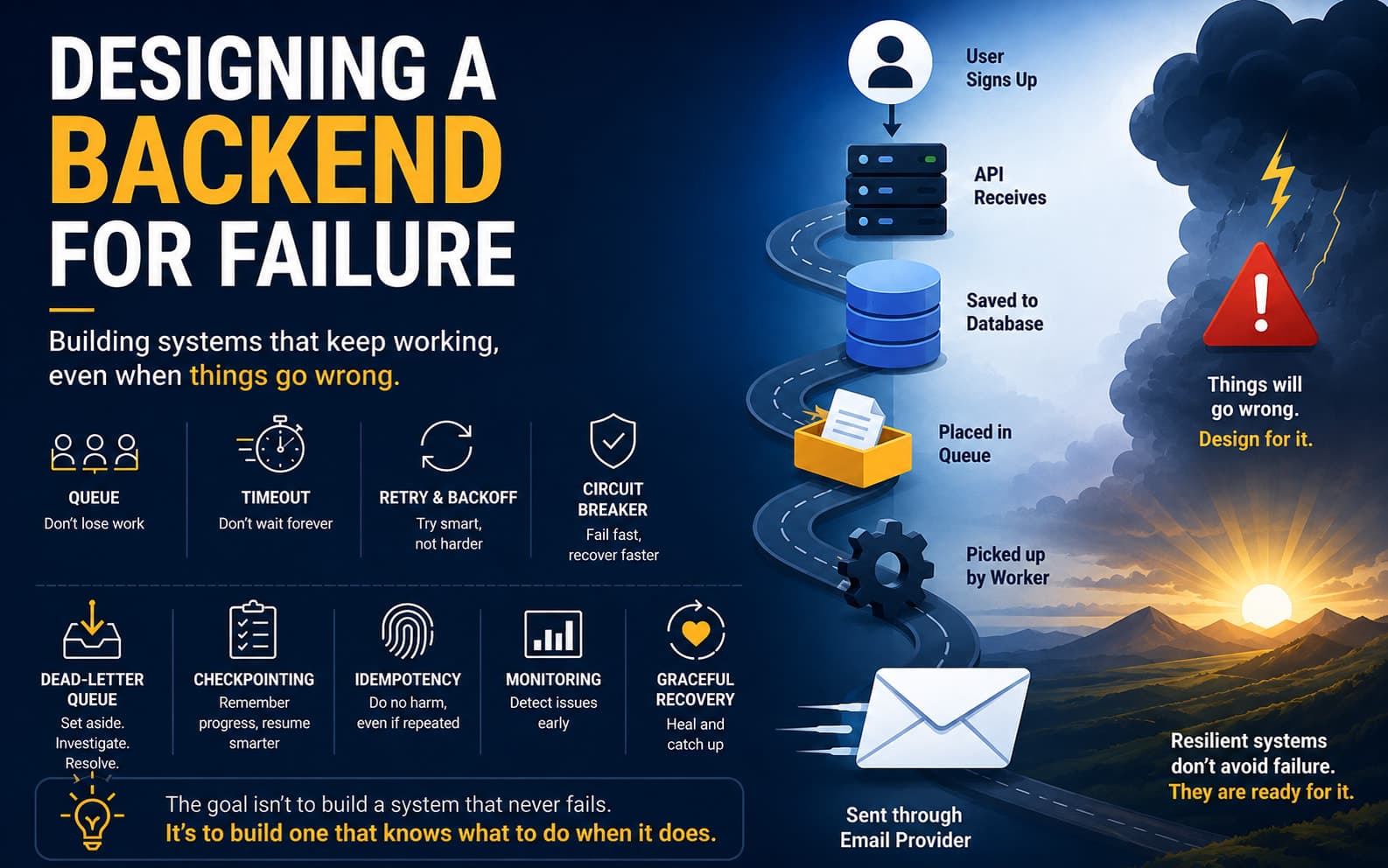
Every backend, the invisible engine behind every app, website, or service, eventually fails. Not usually in one big dramatic crash, but in small, quiet ways: a request takes too long, a message gets sent twice, a provider your system depends on suddenly stops responding. In any system with enough moving parts, this isn't an accident. It's normal life. So the real goal isn't to build something that never breaks. That's impossible. The goal is to build something that keeps working, in some form, even when parts of it are struggling.
The easiest way to understand this isn't through theory. It's through a scenario almost every startup backend has: sending an email.
A Simple, Everyday Scenario
Imagine a new user signs up on your app, and your system needs to send them a welcome email. On a normal day, it looks like this:
User creates account
↓
API receives it
↓
Saved to Database
↓
Placed in a Queue (a waiting line for background jobs)
↓
Picked up by a Worker (a background process that does the actual work)
↓
Sent through an Email Provider (an outside service that delivers emails)
Nothing complicated. The user signs up, and a few seconds later, an email lands in their inbox. But now imagine the outside email provider goes down for twenty minutes, something completely outside your control.
What Happens When It Breaks
Without any planning, this would mean lost emails, confused users, and a pile-up of failed jobs no one notices until support tickets start coming in. With the right design, here's what actually happens instead:
Worker tries to send the email
↓
Provider takes too long to respond
↓
Timeout: the worker gives up waiting instead of hanging forever
↓
Retry: it waits a moment and tries again
↓
Backoff: each retry waits a little longer than the last, so the system
isn't hammering an already struggling provider
↓
Still failing after several attempts
↓
Circuit breaker trips: the system stops trying for a while,
instead of endlessly banging on a door no one is answering
↓
The job is set aside in a dead-letter queue: a separate holding
area for jobs that keep failing, so it can be investigated or
retried later without blocking new signups behind it
↓
Once the provider is healthy again, the worker retries the job
and the email finally goes out
The user experience here matters as much as the engineering. They may simply notice the email arrived a little later than usual. Behind the scenes, a lot was quietly handled so that a temporary outage never became a lost email or a broken signup.
Why Each Piece Matters Here
Queue
The waiting line that holds a job the moment something goes wrong. This only works as intended if the queue is set up for durable delivery and the worker only marks a job as "done" after it has actually succeeded. Otherwise, a crash at the wrong moment can still lose work.
Timeout
A limit on how long the worker will wait for the provider to respond, so one slow provider doesn't freeze everything behind it.
Retry With Backoff
Trying again after a short wait, with that wait growing each time, so the system gives the provider room to recover instead of adding to the pressure.
Circuit Breaker
Once failures happen too many times in a row, the system stops calling the provider entirely for a while, rather than wasting effort on something that clearly isn't working.
Dead-Letter Queue
A safety net for jobs that fail repeatedly even after retries, so they're set aside for review instead of looping forever or quietly disappearing.
Checkpointing
Most useful when a worker is handling a large batch job, like sending a digest email to ten thousand users at once. If it fails partway through, it remembers who's already been sent the email, so it doesn't restart the whole batch from the beginning. For a single email like this one, it matters less, but it becomes essential the moment jobs get larger or longer-running.
Idempotency
A safeguard that helps ensure that if the same job accidentally gets picked up twice, your system doesn't attempt to send the email a second time. It's worth noting that once an outside provider is involved, "exactly once" delivery can never be fully guaranteed. Idempotency protects your own system from doing duplicate work, which is the part you can actually control.
Monitoring
Behind the scenes, someone, or something automated, is watching queue length, retry counts, and how often the circuit breaker is tripping, so a growing problem gets noticed in minutes, not after a wave of complaints.
Graceful Recovery
The whole point of everything above. When the provider comes back, the system heals itself and catches up, instead of needing a person to manually fix things at 2 a.m.
Testing It Before It Happens for Real
Confidence in a system like this doesn't come from hoping it works. It comes from testing it on purpose. Turning off the email provider in a safe test environment and watching whether the queue holds up, the retries behave, and the circuit breaker kicks in is one of the best ways to verify that your failure paths actually behave as designed, rather than assuming they will.
The Bigger Idea
A backend built this way, whether it's written in Python or anything else, isn't trying to be unbreakable. It's built with the understanding that things will go wrong sometimes: providers go down, networks hiccup, jobs fail halfway through. What makes it resilient isn't avoiding that reality. It's having a clear, quiet plan for what happens next.
That's really what resilience means: not a system that never fails, but one that already knows exactly what to do when it does.
What's one failure-handling habit that's saved your team the most in production?