Why It Works Isn't the Finish Line
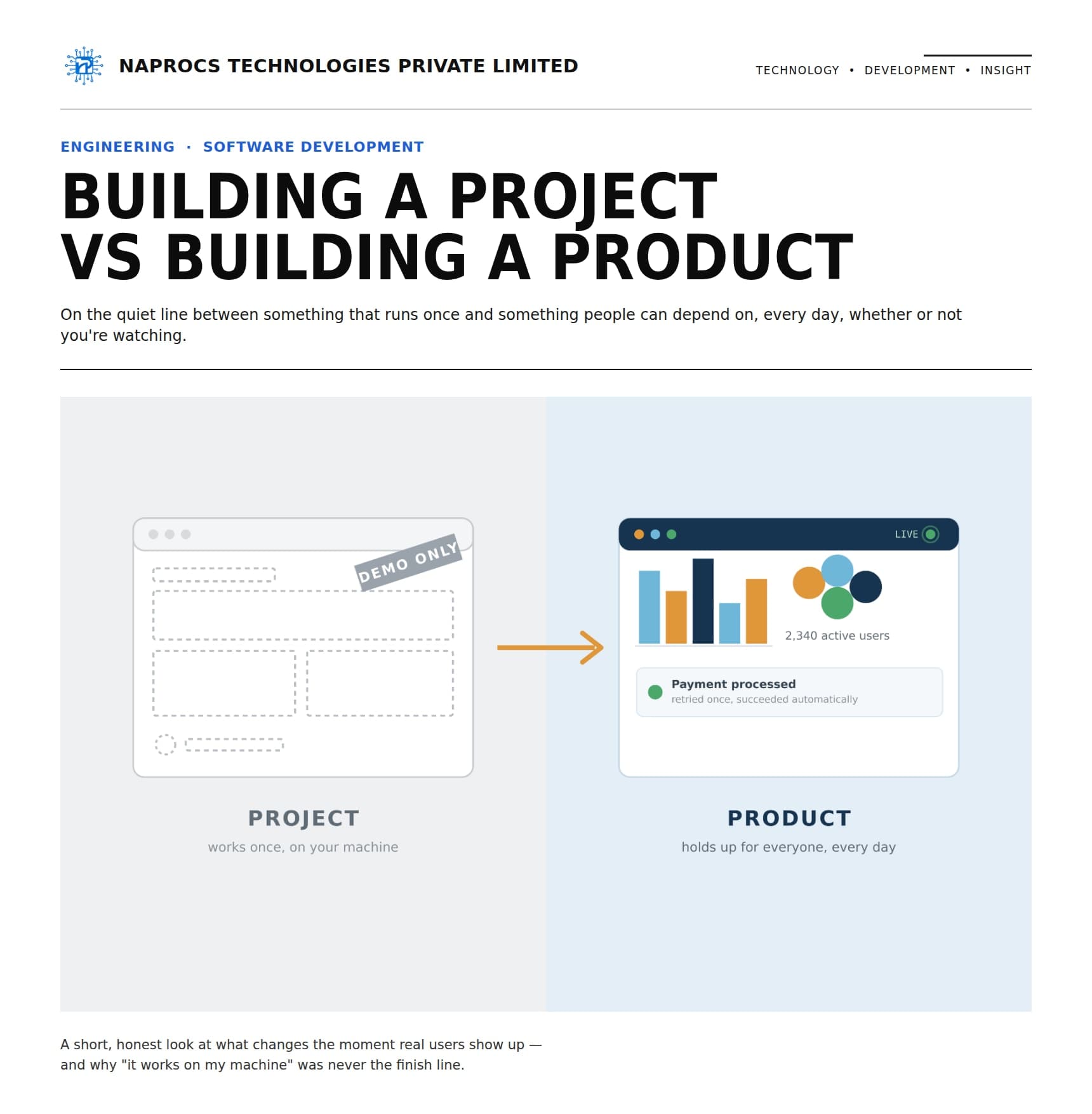
A project just has to run once — you hit build, watch it work, and move on. A product doesn't get that luxury. It has real users, real failures, and things you never tested for, depending on it every day whether you're watching or not. A demo only has to survive the one path you rehearsed; a product has to survive two people clicking the same button at once, a database that blinks out for a second, a request that lands twice, a user doing something you never imagined.
None of that shows up on your laptop — it only shows up once real people are using the thing, which is exactly why deployment changes everything. Your machine, your data, your assumptions are all fixed and known. Production has none of that, so the boring parts start to matter: configs that behave differently per environment, a deploy process you can trust twice in a row, logs that tell you something broke before a user does, and just enough security hardening that one bad request doesn't take the whole thing down.
What Users Actually Experience
Underneath every clever piece of architecture, a user only ever experiences one of two things: the page loaded, or it didn't. In a project, “that shouldn't normally happen” is often good enough to leave a gap unhandled. Once real people are on the other end, that same gap stops being a shrug and starts being a bug report.
Taking Ownership Changes How You Think
Somewhere in all this, the way you think about your own work shifts too. “I finished the API” turns into “what happens when it fails.” “It works” turns into “will it hold up at scale.” “The database has the data” turns into “is the data consistent.” You stop finishing tasks and start owning outcomes — building a feature gives way to solving a problem, and making something work gives way to making it reliable. Once that clicks, “done” stops feeling like an ending. It's just a pause before the next round of build, ship, watch, fix, improve.
What It Taught Me
I didn't pick any of this up from a book — I got it from shipping something small, watching it break in a way I never saw coming, and sitting with that for a minute before fixing it. Writing the feature turned out to be maybe a third of the job. The rest is everything that happens after — watching how it actually behaves once it's out of your hands, fixing the thing you swore couldn't happen, and getting a little better each time at guessing what might.
These days “done” isn't really a word I reach for anymore. It's more of a checkpoint — I'm not chasing some perfect finished state, just trying to leave things a bit more solid than I found them.