I joined as a backend developer, but the projects I ended up building didn’t stay confined to the backend — I built the APIs, but I also ended up building the dashboards and interfaces that sat on top of them. That full-stack exposure changed how I think about bugs. A problem can start in the database, show up broken in the UI, and only make sense once you’ve traced it all the way through the stack. Over time, I’ve realized the bugs that taught me the most weren’t the easy typos — they were the ones that forced me to actually understand the system end to end instead of just writing code for my one layer of it.
The backend bugs that don’t show themselves right away
Some of the hardest bugs weren’t crashes — they were silent failures. An API returning a 200 with the wrong data. A field saving as null because of a missed validation. A response that worked fine for one user and broke for another because of an edge case I hadn’t considered. These taught me to stop trusting that “no error” means “working correctly,” and to actually verify the data at every step instead of assuming the happy path.
The frontend bugs that only show up for the user
On the frontend, the trickiest bugs were the ones that never showed up in my own testing — a dashboard that didn’t refresh until the page was manually reloaded, a layout that broke on a smaller screen, data that displayed correctly the first time but went stale after a background update. These pushed me to test like a real user would: switching screens, resizing windows, clicking things out of order — not just running through the flow I designed.
The bugs that only exist because two things happen at once
Some of the most confusing issues showed up only under real-world timing — two updates landing at almost the same moment, one overwriting the other, or a screen showing outdated information for a few seconds before catching up. These weren’t bugs I could catch by staring at code; I had to reproduce the exact sequence of events, then work backward from there. That process taught me to think in terms of timing and state, not just logic.
How I actually resolve them
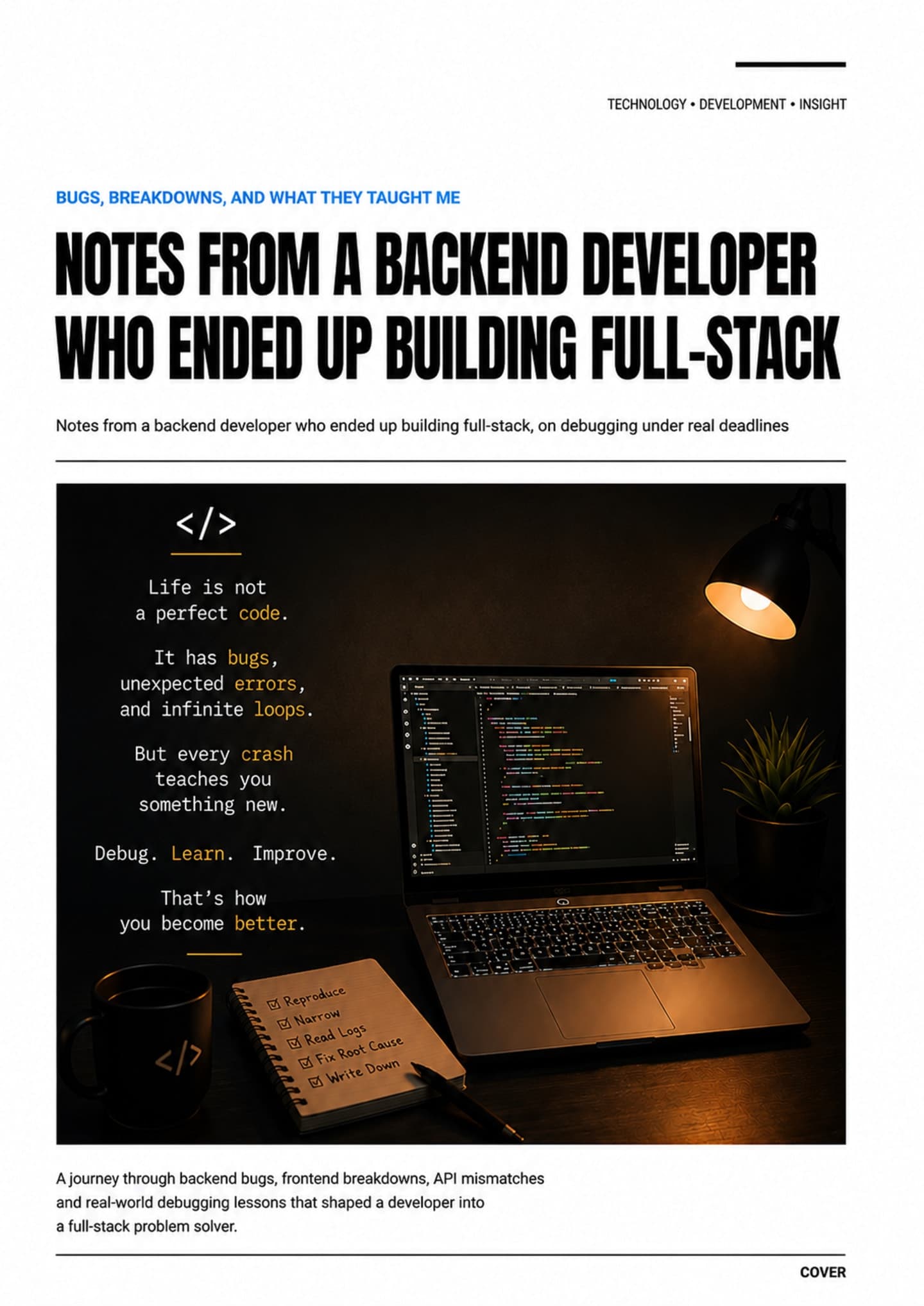
● Reproduce it first — before touching any code, I make sure I can trigger the bug on demand — a fix for a bug I can’t reproduce is just a guess.
● Narrow the layer — check whether the problem is in the data, the API, or the UI before assuming it’s “probably the backend” or “probably the frontend.”
● Read the logs, not just the error — the actual error message is often a symptom; the real cause is usually a few steps earlier in the flow.
● Fix the cause, not the symptom — a quick patch that hides the bug usually means it resurfaces later in a worse form.
● Write it down — a short note on what broke and why makes the next similar bug take five minutes instead of an hour.
None of this makes bugs fun. But every one of them has made me a slightly better engineer than I was before I found it — more careful about assumptions, more patient about tracing a problem to its actual source, and a lot less likely to say “it works on my machine” and call it done. Being a backend developer who’s also had to own the full stack has meant owning the bug end to end too — wherever it actually lives, not just the part of the system I originally signed up for.