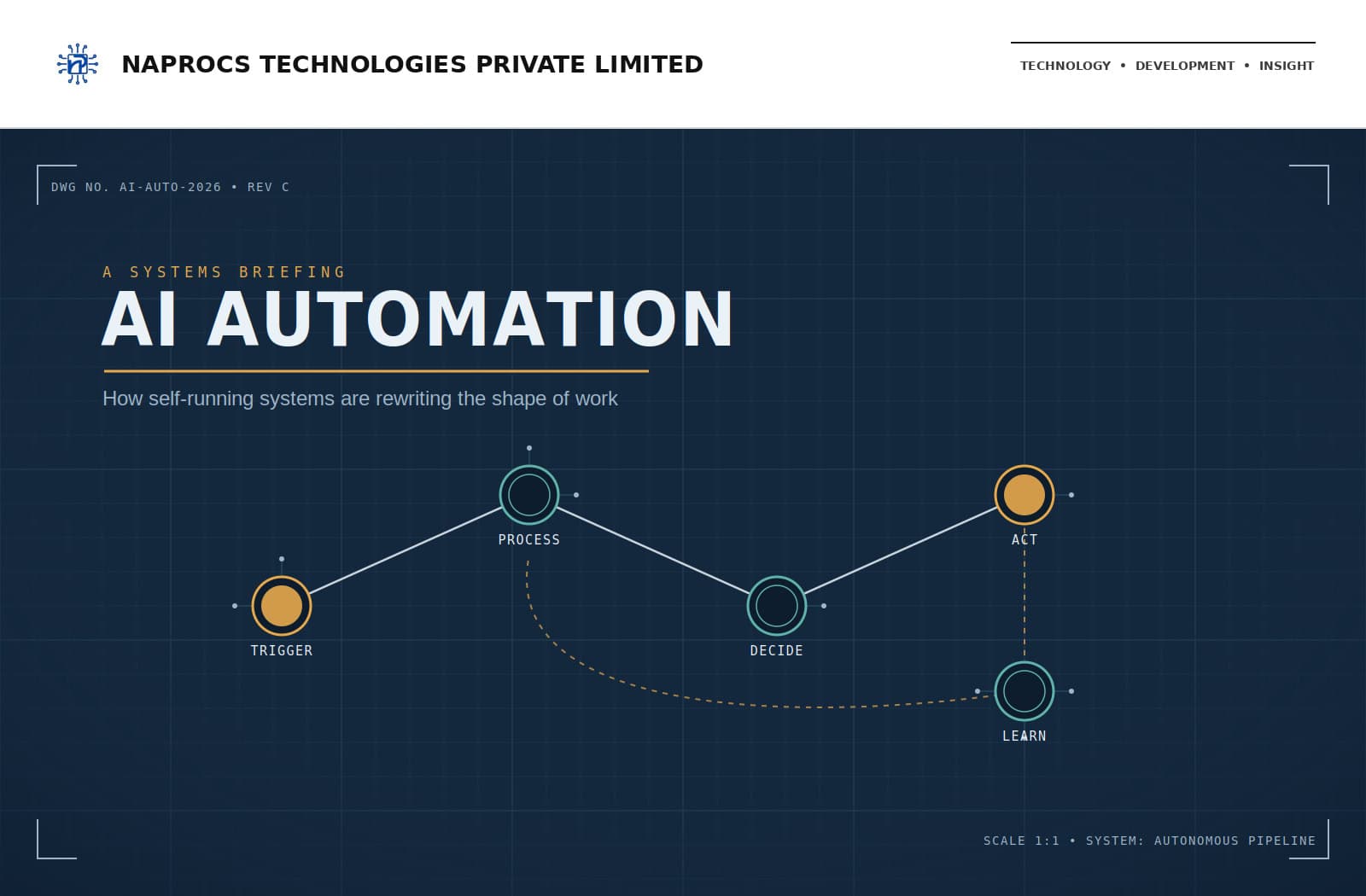
AI automation is one of those terms that gets thrown around a lot right now, in meetings, on LinkedIn, in job postings, without much agreement on what it actually means. Strip away the buzz and it comes down to something fairly simple: using AI to handle tasks that used to need a person watching over every step, not by following a fixed script, but by making small judgment calls along the way.
Where Automation Used to Stop
Traditional automation works by repetition. An Excel macro, a factory robot arm, a scheduled script, all of them run the same fixed sequence every time, and all of them are only as good as their instructions. The moment something outside that script shows up, an unexpected input, a missing field, a slightly different request, the automation breaks or hands the problem back to a person. That's been the ceiling for decades: automation could handle the predictable, but not the messy.
What Actually Changed
AI automation raises that ceiling by adding a layer of interpretation on top of execution. Instead of "if this exact thing happens, do that exact thing," the system can read an unstructured request, work out what's actually being asked, decide on a reasonable next step, and only escalate to a human when something genuinely needs one. That's the real shift, from rule-following to judgment-in-the-loop. It's less about replacing a task outright and more about the system absorbing the in-between decisions that used to require someone paying constant attention.
Why This Is a Different Kind of Trust
Most software earns trust through consistency: click the same button, get the same result, every time. AI automation asks for a different kind of trust, because the system is interpreting something messy, an email written in a hurry, a support ticket with half the details missing, and still landing on a reasonable next step. That's not "did the formula calculate correctly," it's closer to "did this make a sensible call." It's a meaningfully harder thing to verify, and it's the main reason adoption has been careful rather than immediate.
Where It's Actually Being Used
The clearest early use cases aren't glamorous. Sorting and routing customer support tickets, reconciling invoices, summarizing meetings into action items, drafting a first pass of code, flagging anomalies in server logs before they turn into outages. These tasks share three traits: they happen often, the input is semi-structured rather than rigidly formatted, and a mistake is recoverable rather than catastrophic. That combination makes them the natural starting point, high volume and low risk, which is exactly where a system that's good but not yet perfect can prove itself.
The Real Bottleneck Is Trust, Not Capability
Ask teams actually running these systems, and the model itself is rarely the limiting factor. What holds adoption back is confidence in its judgment. Organizations don't just want a tool that's usually right, they want to know when it's likely to be wrong, so a person can step in before something goes sideways. That's why most real deployments keep a human checking the final step, particularly for anything hard to undo, like sending money, deleting a record, or replying to a customer on the company's behalf. The design pattern that keeps showing up is narrower autonomy: limited tool access, clear audit trails, staged rollouts, and explicit checkpoints.
What This Means for Jobs
The common framing is automation as a light switch, a job either exists or it doesn't. In practice this looks more like a job's edges being redrawn than the job disappearing outright. The repetitive middle gets absorbed into a pipeline, while what's left for the person is the part that genuinely needed a human anyway: reading context, making a judgment call, being accountable when something goes wrong. It's a less dramatic story than most headlines suggest, but it matches what's actually happening inside teams that have gone through this shift.
The Bottom Line
AI automation isn't machines taking over jobs overnight. It's the boring, repetitive middle part of a job being absorbed by a system, while the parts that need judgment, relationships, or accountability stay with people. The organizations getting real value from it aren't the ones moving fastest, they're the ones being deliberate about what they hand off and disciplined about monitoring how it performs. Treated that way, it's less a single piece of software to install and more an ongoing design decision about which parts of a workflow deserve a person, and which don't.