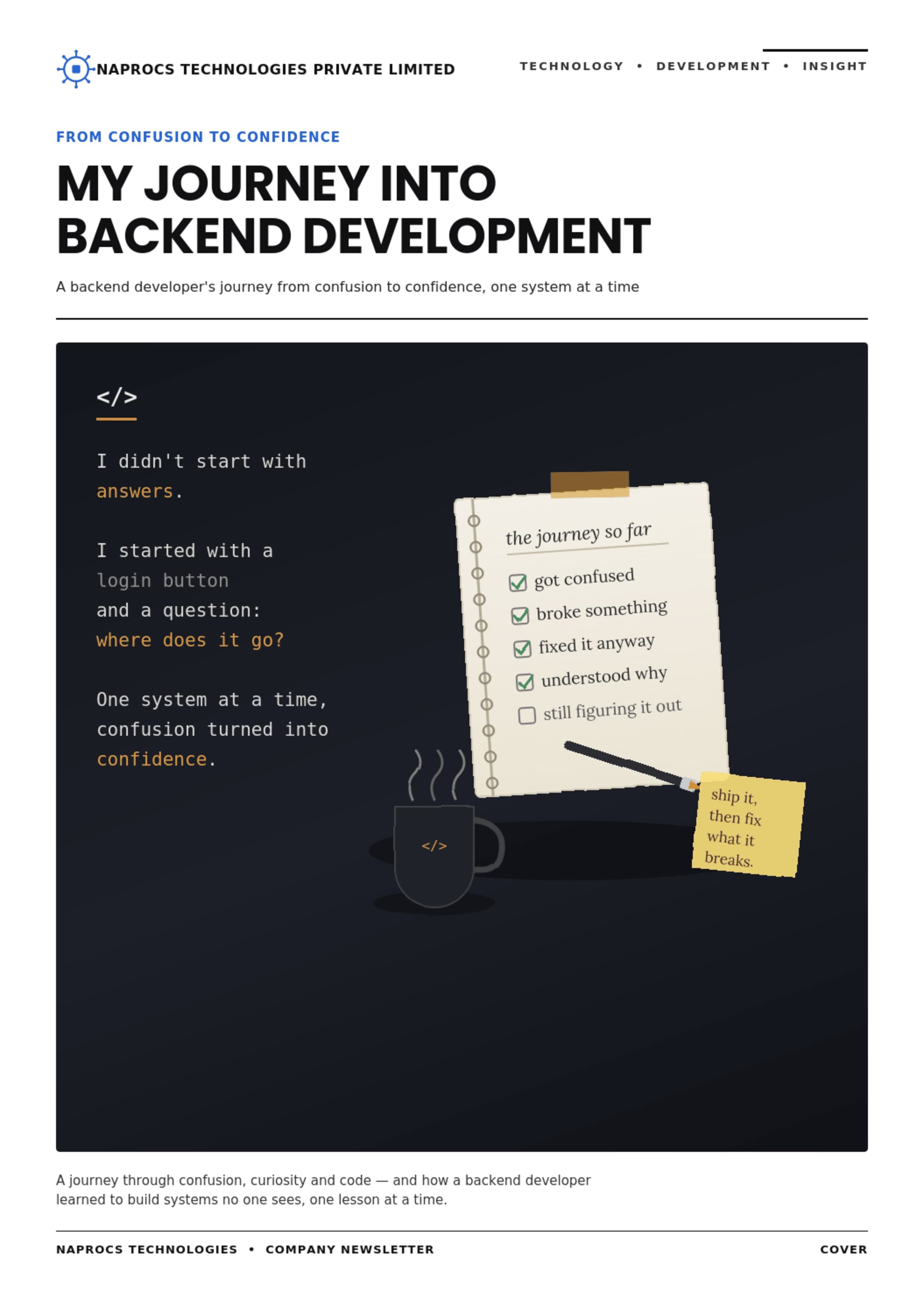
When I started out, I didn't fully understand what “backend” meant — I just knew it wasn't the part people could see. There was no button to click, no screen to admire, no visible proof that anything was happening at all. What pulled me in wasn't a love for logic on day one; it was curiosity about what actually happened after a form got submitted, after a login button got clicked, after data disappeared into somewhere I couldn't point to. Looking back, that curiosity turned into a career I didn't fully plan for, built one confusing problem at a time.
The stage where nothing made sense yet
In the beginning, backend development felt like memorizing syntax without understanding why any of it mattered. I could follow a tutorial and get an API to return “Hello World,” but I couldn't explain what happened between the request and the response. Terms like middleware, authentication, and database indexing floated around without sticking to anything real. I wasn't building systems yet — I was copying patterns and hoping they held together.
The point where I stopped copying and started understanding
The shift happened when I stopped asking “how do I make this work” and started asking “why does this work this way.” Once I understood that an API is really just a contract between two systems that don't trust each other by default, authentication started making sense. Once I understood that a database is a promise about how data will behave under pressure, indexing and normalization stopped being abstract rules and started being decisions. Backend development stopped being a checklist and became a way of thinking about systems — what happens when they're used correctly, and what happens when they're not.
The part nobody warns you about: it never stops being humbling
Every time I felt like I finally understood backend development, something reminded me I didn't — a race condition I hadn't considered, a query that worked fine at ten records and fell over at ten thousand, a service that behaved perfectly until it had to talk to another service under load. That never really goes away. What changes is how you respond to it: less panic, more curiosity, and a growing habit of assuming there's a layer underneath the one you're looking at that you haven't checked yet.
What I'd tell myself if I were starting today
• Understand the request/response cycle before anything else — almost everything in backend development is a variation on this one idea.
• Learn databases before frameworks — frameworks change every few years; how data actually behaves does not.
• Break things on purpose — a system you've intentionally pushed to failure teaches you more than one that's simply worked so far.
• Read other people's systems, not just your own — you learn design decisions faster from someone else's tradeoffs than from your own successes.
• Stay curious about the layer you don't own — the backend developers who grow fastest are the ones who never stop being interested in what's happening on the other side of their API.
I didn't choose backend development because I had it all figured out — I chose it because I liked not fully understanding how something worked, and I liked it even more once I did. Looking back at where I started, the biggest difference isn't how much I know now. It's that I've learned to be comfortable not knowing yet, and to trust the process of finding out.